Wolf Admin. invests $11.9 million, preserves 48 new farms, 4,432 acres

Secretary of Agriculture: Urbanization Threatens Agricultural Lands,

Farmland Preservation Key to Future of Food Security

Mechanicsburg, PA – At the Deckman family farm in Cumberland County today, Agriculture Secretary Russell Redding announced an $11.9 million investment in food security by safeguarding 4,432 acres on 48 farms in 25 counties through the state’s nation-leading farmland preservation program. County governments invested an additional $2 million in the farms preserved today, bringing the total investment to $13.9 million.

“Agricultural development and farmland preservation are inextricably tied to food security and nutrition, it’s critical to increasing the quantity and diversity of food and driving economic transformation,” said Secretary Redding. “The acreage preserved today is an act of looking to the future food needs of Pennsylvanians, the nation, and the world. COVID-19 has placed a microscope on the availability of food, our most basic need. Preserving farmland is the first step to ensuring food is available tomorrow.”

Today’s announcement was held in Mechanicsburg at the 55-acre Deckman Farm, one of the 48 farms preserved by Pennsylvania’s Agricultural Land Preservation Board.

“Pennsylvania continues to lead the nation in the number of farms and acres permanently preserved in agriculture production,” said Cumberland County Commissioner Vince DiFilippo. “Our state must continue to be a leader and to safeguard the investment made to Pennsylvania agriculture.”

According to a 2020 American Farmland Trust report, Farms Under Threat, Pennsylvania lost an alarming 244,000 acres to housing development from 2001 to 2016. This loss was countered by permanently preserving 347,000 acres of farmland during that same time period. Since the inception of Pennsylvania’s Farmland Preservation Program in 1988, the state has preserved more than 5,700 farms and 584,000 acres of Pennsylvania’s agricultural land for perpetuity with a more than $1.6 billion investment.

The COVID-19 pandemic has shown many Pennsylvanians empty grocery store shelves for the first time in their life, leading to a heightened awareness of where food comes from and how it gets from farm to shelf. Access to farmland is vital to food security and meeting demands in both a regular and crisis climate.

In 2019, an agriculture research study funded by the department and conducted by Dr. Thomas Daniels, University of Pennsylvania, found the total economic impact of farmland preservation in Pennsylvania to be valued from $1.8 to $2.9 billion annually. The report also concluded environmental benefits of farmland preservation to be estimated at an additional $1.9 billion annually. Through his research, Dr. Daniels found that farmland contributes more in tax dollars than in demands in services.

“Pennsylvania is the leading state in farmland preservation with more than 5,700 preserved farms and 584,000 preserved acres,” said Dr. Daniels, University of Pennsylvania. “Preserved farmland helps support a multi-billion-dollar agricultural industry that is essential for providing long-term food security for the residents of the commonwealth.”

The 48 farms preserved today are in Adams, Armstrong, Berks, Bucks, Chester, Columbia, Cumberland, Erie, Franklin, Greene, Lackawanna, Lawrence, Lehigh, Luzerne, Mifflin, Monroe, Montgomery, Northampton, Schuylkill, Somerset, Susquehanna, Washington, Wayne, Westmoreland, and York counties. Since the program began in 1988, federal, state, county, and local governments have purchased permanent easements on 5,724 farms totaling 584,487 acres in 59 counties for agricultural production.

The farms preserved today include crop, fruit and vegetable, dairy, nursery, beef and livestock operations.

Notable farmland preserved includes 148.86-acre Clayholm Farms, LLC., one of the largest remaining dairy operations in Armstrong County. The Clayholm farm faced hardship during COVID-19 when having to dump their milk due to market loss. The family will be using farmland preservation funds to help offset losses.

Berks County hit a milestone of 75,000 preserved acres after the preservation of a 68.80-acre crop farm, Son-Rise Farm, LLC.

Woodward Brothers Inc. Farm, located next to the historical site of the Battlefield of Brandywine dating back to the Revolutionary War, preserved a 50.74-acre crop farm in Chester County.

A full list of farms preserved:

Adams

The Diane & Ronald Resh Farm #32, a 201-acre fruit and vegetable farm

Armstrong

Clayholm Farms, LLC, a 149-acre dairy farm

Berks

The Marlene E. Blatt Farm #1, a 53-acre crop farm

The Nelson R. & Anna S. Brubaker Farm #2, a 72-acre crop and livestock farm

The Nevin M. & Pauline B. Brubaker Farm, a 27-acre crop farm

The Richard C. & Kathleen Dietrich Farm, an 81-acre crop farm

The Beverly A. Schrack Farm, a 150-acre crop and livestock farm

Son-Rise View, LLC, a 67-acre crop-farm

The Paul B. & Geraldine S. Zimmerman Farm #4, a 24-acre crop farm

Bucks

The Harry & Joan B. Bohlman Farm, a 23-acre nursery farm

Chester

The Frank Palmer & Shirley J. Durborow Farm, a 13-acre livestock farm

Scott Farm Estates, LLC, a 69-acre crop farm

Woodward Brothers, Inc., a 51-acre crop farm

Columbia

The Larry A. & Deborah K. Rhoads Farm #2, a 75-acre crop and livestock farm

Cumberland

The Donald E. & Linda K. Mackey Farm, a 131-acre crop farm

The Marian R. Deckman Living Trust Farm, a 55-acre crop farm

The Leroy J. Strohm Farm, a 121-acre crop farm

The Ward Family Trust Farm, a 155-acre crop and livestock farm

Erie

The John E. & Patricia J. Pfadt Farm, a 56-acre crop and livestock farm

The Mark D. Troyer Farm #1, a 313-acre crop farm

Franklin

Ricecrest Farms #2, a 51-acre crop farm

Greene

The Williams A. & Lura Ann Cree Farm #2, an 83-acre dairy operation

Lackawanna

The Benjamin E. & Allison M. Nogan Farm #1, a 206-acre crop and livestock farm

Lawrence

The Whiting Family Limited Partnership Farm, a 132-acre beef operation

Lehigh

The Kurt J. & Alyssa J. Gerhard Farm, a 21-acre crop farm

L.E.T. Farms, Inc., a 48-acre crop farm

The Scott & Jill K. Mittl Farm, a 13-acre crop farm

The Reinert Farm, an 82-acre crop and livestock farm

The Walter H. Snyder Jr. Farm, a 58-acre crop farm

Luzerne

The Gary & Cathy Moyer Farm, a 106-acre crop and livestock farm

Mifflin

The Leon Donahey Farm #1, 100-acre crop and livestock farm

Monroe

The Brian S. & Kathy L. Beidleman Farm, a 25-acre crop farm

Montgomery

The Suzanne Banyacsky Farm #1, a 24-acre crop farm

The Thomas Latshaw Farm #1, a 61-acre crop farm

The Edward B. Stokes Jr. Farm #1, a 117-acre crop farm

Northampton

The Robert A. Ackerman & Beverly A. Beahn Farm #1, a 50-acre crop farm

The Mark R. Bickert Farm, a 23-acre crop farm

The Jeffrey A. & Kevin M. Brewer Farm, an 80-acre crop farm

The Frederick & Teresa Dockey Family Trust Farm, a 50-acre crop farm

The Mark P. & Lisa I. Matyas Farm, a 99-acre crop farm

The Larry N. & Marion J. Van Horn Farm, a 53-acre crop farm

Schuylkill

The Nelson W. Moyer, Machelle A. Itle, & Megan Shawver Farm, a 50-acre crop and livestock farm

Somerset

The Roger W. & David A. Latuch Farm #1, a 216-acre crop and livestock farm

Susquehanna

The James W. Robertson Farm, a 167-acre crop and livestock farm

Washington

The Gary A. Danley Farm, a 53-acre crop farm

Wayne

The John Pawloski Farm #1, a 116-acre dairy operation

Westmoreland

The Rosa Beth Snyder-Boyd Farm #1, a 181-acre crop and livestock farm

York

The Jonathan Hash Farm #1, a 282-acre crop farm

The Pennsylvania Agricultural Conservation Easement Purchase Program, as it is formally known, is dedicated to slowing the loss of prime farmland to non-agricultural uses. Funding allows state, county, and local governments to purchase conservation easements from owners of quality farmland. State, county, local, and federal funds committed at the meeting are allocated to county programs to purchase development rights to preserve farms on county waiting lists.

Investments in preserving farmland for future production are being further enhanced by investments Governor Tom Wolf made in establishing Pennsylvania’s first-ever PA Farm Bill in 2019. It created the Agriculture Business Development Center to support business planning, marketing, diversification, and transition planning for Pennsylvania farmers. The bill package also included a realty transfer tax exemption for the transfer of preserved farmland to a qualified beginning farmer.

To learn more about Pennsylvania’s Farmland Preservation Program, visit agriculture.pa.gov.

For information as it relates to agriculture during COVID-19 mitigation in Pennsylvania visit agriculture.pa.gov/COVID. For the most accurate, timely information related to Health in Pennsylvania, visit on.pa.gov/coronavirus.

Human Services: Pennsylvanians Must Remain Vigilant about Preventing Child Abuse and Keeping All Kids Safe

Harrisburg, PA – Today, Department of Human Services (DHS) Secretary Teresa Miller urged Pennsylvanians to remain vigilant in our shared responsibility to keep all children safe and prevent child abuse. DHS administers ChildLine, which is a 24/7 hotline available to anyone concerned for the safety or well-being of a child. To report a concern, call 1-800-932-0313.

“While Pennsylvania begins to reopen and some of our lives get back to something close to normal, I want to remind my fellow residents that there are many people – particularly among vulnerable populations – who will continue to feel the effects of this public-health crisis for many months and years to come. And some are still in the shadows,” Secretary Miller said. “We all have a role to play to keep children safe. If you suspect a child is being abused or neglected, please call ChildLine to make a report.”

In the weeks immediately following the implementation of aggressive social-distancing measures to slow the spread of the coronavirus, DHS saw a roughly 50 percent decline in average daily calls to ChildLine compared to the same time period in 2019. This decrease in calls is most likely an unfortunate side effect of school closures and limited interactions between children, their teachers and other mandated reporters in school settings. Of the 39,040 reports made by mandated reporters to ChildLine in 2018, for example, more than a third were reported by school employees.

To address the reduction in calls, DHS has prioritized outreach to stakeholders and external communication efforts to encourage members of the public to be on the lookout for signs of abuse or neglect among children in their community and to call ChildLine if they suspect a child is in danger. Between May 1 and May 28 of this year, ChildLine received 14,181 calls from concerned citizens — down from 23,536 calls during the same time period in 2019, or a roughly 40 percent reduction.

“Calls to ChildLine normally drop during the summer months when schools are closed, but this should only reinforce our efforts to be vigilant about our responsibility to protect all children,” Secretary Miller said. “Each and every one of us can play a role in protecting children from abuse or neglect. Making the call to ChildLine allows trained child welfare professionals and, if necessary, law enforcement to follow up, collect information, and determine if assistive services or other intervention is necessary.”

Anyone can make a report to ChildLine. Anyone who is not a mandated reporter can make a report to ChildLine anonymously. DHS is encouraging all Pennsylvanians to learn more about the signs of potential abuse or neglect and make a report to ChildLine if they begin to suspect abuse or neglect.

Signs of potential abuse or neglect can include:

  • Numerous and/or unexplained injuries or bruises;
  • Chronic, pronounced anxiety and expressed feelings of inadequacy;
  • Flinching or an avoidance to being touched;
  • Poor impulse control;
  • Demonstrating abusive behavior or talk;
  • Cruelty to animals or others; and,
  • Fear of parent or caregiver, among others.

DHS also encourages parents and families who are struggling to cope during this time of crisis to reach out for help. Anyone struggling with mental health and in need of referrals to helpful programs can call Pennsylvania’s new Support & Referral Helpline, which is operated 24/7 by skilled caseworkers who can provide emotional support during this difficult period. The number to call is 1-855-284-2494. For TTY, dial 724-631-5600. Another helpful resource is the 2-1-1 hotline operated by the United Way, which can connect people and families to local resources that can help during the public health crisis.

HHS Issues Request for Application for Regional Response Health Collaboration Program

Harrisburg, PA – The Department of Human Services (DHS) today announced a Request for Applications (RFA) for its new Regional Response Health Collaboration Program (RRHCP). The RRHCP is designed to directly support COVID-19 readiness and response in long-term residential care facilities, improve infection prevention, and facilitate continuity of care and other services provided by long-term care facilities in a manner that mitigates risk of spread of COVID-19 to staff or residents.

“Long-term care providers provide a home and care for some of the most vulnerable Pennsylvanians. We want these providers to know that the Wolf Administration will do everything it can to support them during this pandemic and beyond,” said DHS Secretary Teresa Miller. “We hope that this new collaboration program will provide long-term care facilities with additional support they need to fight COVID-19 and learn, respond, and prepare for future health crises.”

More than 45,000 Pennsylvanians live in more than 1,200 personal care homes and assisted living residences, and more than 80,000 residents live in 693 skilled nursing facilities throughout the commonwealth. These residents are often some of the most vulnerable and susceptible to COVID-19 due to age, presence of existing health conditions that may lead to complications, and the congregate nature of these facilities.

The RHCCP will provide operations, management, and administrative support to protect residents in long-term care facilities from COVID-19. It will help those facilities implement best practices in infection control, implement contact tracing programs in facilities, support clinical care through on-site and telemedicine services, provide remote monitoring and consultation with physicians, and enhance testing capability for both individuals in care and staff at facilities. The RRHCP will assist in identifying alternate care arrangements for hospitalized COVID-19  patients until they are considered no longer infectious and can be safely returned to their long-term care facilities.

The RRHCP is based on the Educational Support and Clinical Coaching Program (ESCCP), a learning network that provides technical assistance and educational support to long-term care facilities in light of the current pandemic. Unlike the ESCCP, which operates on a voluntary basis, the RRHCP will operate under grant agreements. Selected grantees will be awarded $175 million collectively, with funding approved by the General Assembly.

Responses to this RFA are due by June 25, 2020. Applicants can submit questions by no later than June 15, 2020.  Applications can be found online through eMarketplace DHS hopes to have agreements in place for the RRHCP by July 1, 2020.

Visit pa.gov for a “Responding to COVID-19” guide or the Pennsylvania Department of Health’s dedicated Coronavirus webpage for the most up-to-date information regarding COVID-19.

Guidance to DHS providers related to COVID-19 is available here.

Lycoming County remains at 168 total positive cases, 164 confirmed and 4 probable. Additionally, 17 deaths all occuring in nursing homes according to Thursday DOH report

Department of Health Provides Update on COVID-19,

467 Positives Bring Statewide Total to 77,313

Harrisburg, PA – The Pennsylvania Department of Health today confirmed as of 12:00 a.m., June 11, that there are 467 additional positive cases of COVID-19, bringing the statewide total to 77,313. All 67 counties in Pennsylvania have cases of COVID-19.

There are 6,113 total deaths attributed to COVID-19, an increase of 51 new deaths. County-specific information and a statewide map are available here.

“With more than half of the state now in the green phase of the process to reopen, it is essential that we continue to take precautions to protect against COVID-19,” Secretary of Health Dr. Rachel Levine said. “Each of us has a responsibility to protect ourselves, our loved ones and others by wearing a mask, maintaining social distancing and washing our hands frequently. Together we can protect our most vulnerable Pennsylvanians, our essential workers and our healthcare system.”

There are 630 patients who have a positive serology test and either COVID-19 symptoms or a high-risk exposure, which are considered probable cases and not confirmed cases. There are 476,439 patients who have tested negative to date. Of the patients who have tested positive to date the age breakdown is as follows:

  • Nearly 1% are ages 0-4;
  • Nearly 1% are ages 5-12;
  • Nearly 2% are ages 13-18;
  • 6% are ages 19-24;
  • Nearly 37% are ages 25-49;
  • 25% are ages 50-64; and
  • 28% are ages 65 or older.

Most of the patients hospitalized are ages 65 or older, and most of the deaths have occurred in patients 65 or older. More data is available here.

In nursing and personal care homes, there are 16,357 resident cases of COVID-19, and 2,871 cases among employees, for a total of 19,228 at 627 distinct facilities in 45 counties. Out of our total deaths, 4,215 have occurred in residents from nursing or personal care facilities. A county breakdown can be found here.

Approximately 5,888 of our total cases are in health care workers.

For the latest information for individuals, families, businesses and schools, visit “Responding to COVID-19” on pa.gov.

Currently, all 67 counties are in the yellow or green phase of reopening.

The Wolf Administration stresses the role Pennsylvanians play in helping to reduce the spread of COVID-19:

  • Wash your hands with soap and water for at least 20 seconds or use hand sanitizer if soap and water are not available.
  • Cover any coughs or sneezes with your elbow, not your hands.
  • Clean surfaces frequently.
  • Stay home to avoid spreading COVID-19, especially if you are unwell.
  • If you must go out for a life-sustaining reason, please wear a mask.

Statewide – The Wolf Administration has since noon, June 10:

Updated Coronavirus Links: Press Releases, State Lab Photos, Graphics

All Pennsylvania residents are encouraged to sign up for AlertPA, a text notification system for health, weather, and other important alerts like COVID-19 updates from commonwealth agencies. Residents can sign up online at www.ready.pa.gov/BeInformed/Signup-For-Alerts.

Wolf Admin. Announces New COVID-19 Funding Available for PA Counties

Counties Can Apply for Community Block Grant Funding

Harrisburg, PA – Today, Department of Community and Economic Development (DCED) Secretary Dennis Davin announced that new funding is available to 60 Pennsylvania counties under the COVID-19 County Relief Block Grant.

“As Pennsylvania continues on its road to recovery after efforts to mitigate the spread of COVID-19, it is critical that we provide any and all assistance to Pennsylvania’s communities and businesses in a widespread and expedient manner,” said Sec. Davin. “This new funding will help Pennsylvania’s counties repair, recover, and reimagine the future that is waiting post-COVID-19.”

Guidelines, applications, and eligible counties can be found here.

Under the program, $625 million was made available to Pennsylvania counties in Coronavirus Aid, Relief, and Economic Security (CARES) Act funding in the form of block grants administered by DCED. This funding may be used to offset the cost of direct county COVID-19 response, assist municipalities with COVID-19 response and planning efforts, fund nonprofit assistance programs, and deploy broadband to unserved or underserved areas.

Eligible expenditures must have been incurred between March 1, 2020 and December 30, 2020. Formula-driven funding will be made available to the 60 counties that did not previously receive direct assistance via the CARES Act, with a minimum allocation of $1 million. The counties that have already received direct assistance are Allegheny, Bucks, Chester, Delaware, Lancaster, Montgomery and Philadelphia.

Applications must be received by June 16, 2020. All applications for the County COVID-19 County Relief Block Grant must be completed and submitted online using DCED’s Single Application at dced.pa.gov or www.esa.dced.state.pa.us. Paper applications will not be accepted.

Applicants should carefully follow instructions outlined in the online Single Application and provide requested information. Questions can be directed to DCED Customer Service at 1-800-379-7448 or ra-dcedcs@pa.gov.

The CARES Act was passed by Congress and signed into law on March 27, 2020.  The $2 trillion economic relief package aims to protect the American people from the public health and economic impacts of COVID-19. The CARES Act provides economic assistance for local governments and American workers, families, and small businesses.

For the most up-to-date information on COVID-19, Pennsylvanians should follow https://www.pa.gov/guides/responding-to-covid-19/.

New natural gas service begins in Centre Hall Service will support hundreds of new customers

CENTRE HALL – Natural gas is now flowing to a major food processing plant and will be soon to small businesses and over 100 homes in its initial phase.

This is thanks to the Centre Hall Natural Gas Project and its partners, said Pete Smeltz, president of the SEDA-COG Natural Gas Cooperative.

“This project has progressed rapidly since its groundbreaking last September. It demonstrates how the SEDA-COG Natural Gas Cooperative forms partnerships and leverages funds to help businesses and residents access natural gas when they can’t otherwise,” Smeltz said. “We are so appreciative of our participating supporters – Hanover Foods Corporation, Columbia Gas of Pennsylvania, Dominion Energy Transmission, the state of Pennsylvania, state Sen. Jake Corman, state Rep. Kerry Benninghoff, Centre County Planning and Community Development Office, and Centre Hall Borough.”

The largest business the project serves is Hanover Foods Corporation.

Attorney Matthew Garber of McNees Wallace & Nurick LLC, counsel for Hanover Foods, said, “Hanover Foods is pleased to utilize a cleaner and more cost-efficient resource, to strengthen its operational capabilities, and to support development throughout the Centre County region.”

Over 100 residents and businesses along the main pipeline route have been able to convert to natural gas because of opportunities provided by Columbia Gas.

Mike Huwar, Columbia Gas president and COO, said this presents new economic opportunities for the area.

“Columbia Gas is honored to expand access to natural gas to customers in Centre Hall through this project while creating new jobs and new economic opportunities,” Huwar said. “Going forward, safely operating this system will be our responsibility for years to come. We take that responsibility for safety seriously —for our customers, for our communities, and for our employees.”

Centre Hall Mayor Ray Hankinson, who serves on the cooperative board, said this project is much needed in the borough to support jobs and cost savings for businesses and homeowners alike.

“This is an exciting first project for the cooperative and our borough – and a great milestone for central Pennsylvanians. Our small borough could never have planned and coordinated the resources it took to bring this project into existence. I hope this becomes a drawing card for new business in our area,” Hankinson said.

The project provides natural gas service through a new a point of delivery station and delivery pipeline network that connects to a Dominion Energy natural gas transmission line west of Centre Hall Borough, runs through Centre Hall, and out to Hanover Foods in Potter Township. Columbia Gas built a 25,425-foot mainline pipeline delivery system to serve Centre Hall, Hanover Foods, and other businesses and residents. The initial project phase will continue to be expanded to serve additional residences and businesses over time.

Columbia Gas owns and operates the point of delivery station and the delivery system. The cooperative procured and managed funding and has supported marketing efforts to add new customers.

The $7 million project was financed by a $1 million Pipeline Investment Program (PIPE) grant from the Commonwealth of Pennsylvania, Commonwealth Financing Authority, and matching funds from Columbia Gas and Hanover Foods.

The SEDA-COG Natural Gas Cooperative, established in June 2016, provides project funding and forms partnerships to expand natural gas distribution infrastructure to its member counties Centre, Clinton, Juniata, Mifflin, Montour, Northumberland, Perry, and Union and SEDA-Council of Governments (SEDA-COG). For more information, visit http://centralpagas.org/.

Human Services Extends Emergency Assistance Program, Help with Home Energy Crisis Funding and School Meals Available

Harrisburg, PA –Department of Human Services (DHS) today announced a one-month extension of the temporary Emergency Assistance Program (EAP) and reminded Pennsylvanians of other assistance programs that remain available as the commonwealth reopens and Pennsylvanians recover from economic challenges caused by COVID-19.

“We know these times are extremely challenging, but you do not have to go through this period alone. If you need help feeding your children, cooling your home, or affording other necessities, DHS is here for you,” said DHS Secretary Teresa Miller. “There is no shame in asking for help when we need it. DHS will be here to support Pennsylvanians through this public health crisis now and in the weeks and months to follow, and I encourage any Pennsylvanians in need of assistance to apply for these programs.”

Pennsylvanians who have experienced a change in income or job loss, regardless of its relation to the COVID-19 pandemic, can apply for benefits online at any time at www.compass.state.pa.us. Those who prefer to submit paper applications can mail documents to their local County Assistance Office (CAO) or leave documents in a CAO’s secure drop box, if available. CAOs remain closed to the public, but mail and drop boxes are being monitored so applications can be processed.

DHS administers Medicaid, the Supplemental Nutrition Assistance Program (SNAP), the Children’s Health Insurance Program (CHIP), the Low-Income Home Energy Assistance Program (LIHEAP), and Temporary Assistance for Needy Families (TANF).

DHS has also received approval to administer three benefits created specifically in response to the COVID-19 pandemic. They are:

Emergency Assistance Program

The Emergency Assistance Program (EAP) helps low-income families who have lost wages and are experiencing financial challenges due to the COVID-19 pandemic. The program uses existing Temporary Assistance for Needy Families (TANF) funds and is open to families with a child under the age of 18 or a woman who is currently pregnant. Families who qualify for EAP will be eligible for a one-time payment to assist them in meeting basic needs and to help them secure more stable financial footing in the future.

In order to qualify, families must have at least one person in the household who was employed as of March 11, 2020 and experienced an hour or wage reduction of at least 50 percent for two weeks or more, or who lost employment entirely due to the public health crisis. Eligible families can possess resources, such as money in checking/savings, of no more than $1,000 as well.

Qualifying families are issued a one-time grant equal to two months of TANF benefits. The average monthly TANF grant for a family of three is $403, so a qualifying family of three receiving the average would receive a one-time grant of $806 through the program. Information on monthly grants by household size and county is available online here. Funds will be issued through an electronic benefit transfer (EBT) card.

Funds remain available and this program has been extended; applications are due by July 12. Families should be prepared to submit all necessary documentation with their application to expedite processing and avoid having to apply again. Applications are accepted at any time, and previously rejected applications can be resubmitted. More information about EAP, including income limits, is available here.

Low-Income Home Energy Assistance Program (LIHEAP) Recovery Crisis

LIHEAP provides assistance for home energy bills, helping ensure continuity of utility and other energy services for low-income Pennsylvanians. LIHEAP normally runs from November through March, but the Recovery Crisis program can help with Pennsylvanians’ current energy costs, including critical air conditioning during the summer months. Assistance is available for both renters and homeowners.

The LIHEAP Recovery Crisis Program will offer a crisis benefit and a supplemental payment for households that previously received a crisis payment made directly to utility companies or fuel providers to help offset costs for home utilities.

LIHEAP Recovery Crisis benefits may be available if a household:

  1. Has their main or secondary energy source completely shut-off;
  2. Is notified that their utility service will be shut off in the next 60 days;
  3. Has broken energy equipment or leaking lines that must be fixed or replace; or,
  4. Is in danger of being without fuel in 15 days or less.
  5. Owes funds to a utility provider that would constitute a service termination if not for the Public Utility Commission’s moratorium on terminations.

LIHEAP Recovery Crisis program will run through August 31, 2020, or until all budgeted funding is expended. More information about the LIHEAP Recovery Crisis Program, including income limits, can be found here.

Pandemic Electronic Benefit Transfer

The Pandemic Electronic Benefit Transfer (P-EBT) program is a temporary program designed to bridge the gap left by schools closing and help families who may have strained resources due to the COVID-19 pandemic. The program allows for DHS, in partnership with the Pennsylvania Department of Education, to provide a P-EBT benefit to households with children who have lost access to free or reduced-price school meals through the National School Lunch Program due to pandemic-related school closures. P-EBT benefits are automatically issued to National School Lunch Program-qualifying families and will be received as EBT cards.

Benefits are provided to all eligible children whether or not they currently receive SNAP benefits. A family’s benefit is determined based on the federal reimbursement rate for the daily rate of free school breakfasts and lunches, or approximately $5.70 per child. This benefit is calculated with a pre-determined number of days based on when the child became eligible for the National School Lunch Program. While families do not apply directly for P-EBT, families who have experienced a job loss or change in income can still apply for the National School Lunch Program for the 2019-2020 school year through June 12.

Additional questions about Pennsylvania’s P-EBT, including further eligibility determinations, can be found here.

Applications for  EAP, LIHEAP Recovery Crisis, and the National School Lunch Program  can be made online at www.compass.state.pa.us. Pennsylvanians do not need to know their own eligibility in order to apply for these programs.

Visit pa.gov for a “Responding to COVID-19” guide or the Pennsylvania Department of Health’s  dedicated Coronavirus webpage for the most up-to-date information regarding COVID-19.

Guidance to DHS providers related to COVID-19 is available here.

PA Post: Pa. courts may avoid definitive ruling in legal fight over governor’s emergency powers

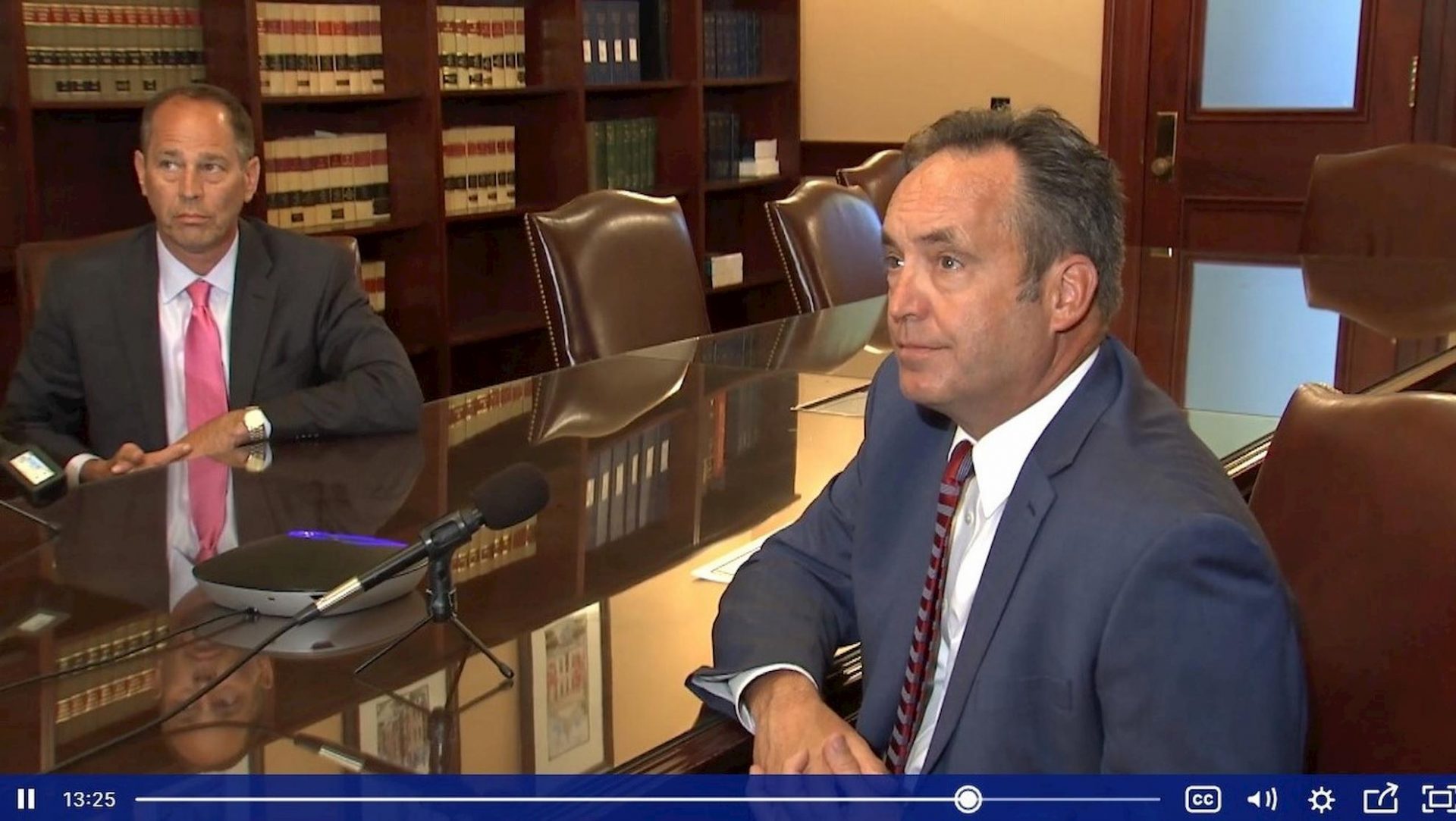
General Counsel of the Commonwealth Gregory G. Schwab, speaks during a press conference addressing the 2019 Novel Coronavirus (COVID-19) in Pennsylvania, inside PEMA headquarters on Wednesday, June 10, 2020.

While both governor and legislature want quick action, judiciary likely to proceed deliberately

  • Benjamin Pontz

Courtesy PA Senate Republican Caucus

A screenshot of a Pa. Senate GOP livestream shows Majority Leader Jake Corman (foreground) and Senate President Pro Tem Joe Scarnati discussing a newly passed budget bill on May 28, 2020.

It took less than 24 hours for the Pennsylvania General Assembly and governor to wind up in a legal fight that could have far-reaching implications for how state leaders respond to future emergencies.

First, the state Senate debated and passed a resolution to revoke the emergency order Gov. Tom Wolf issued in March in response to the coronavirus epidemic. In a matter of hours, the House concurred with the Senate’s resolution, and legislators said their action did not require Wolf’s assent.

Then, in a 1 p.m. news conference on Wednesday, Wolf threatened to take the legislators to court over the matter, but before he could do that the legislature sued Wolf in Commonwealth Court.

Both the governor and the legislature say they want the court to resolve the matter, which has been the source of consternation for weeks, once and for all.

But according to two legal scholars, the court may not be in any rush to do so, at least not in any definitive way.

“Courts can avoid taking an affirmative stance on thorny, highly politicized cases by dismissing them on procedural grounds, and that may certainly happen here,” said Dr. Scott Boddery, a political science professor at Gettysburg College who studies court legitimacy and judicial behavior.

In the lawsuit filed Wednesday afternoon, Senate GOP leaders Joe Scarnati (R-Jefferson) and Jake Corman (R-Centre) asked the court to direct Wolf to issue a proclamation ending his coronavirus disaster declaration, which, they say, he is required to do under Title 35 of the state code.

While Wolf maintains that all resolutions passed by the legislature require his signature under the state constitution, the senators argued in their filing that the statute says otherwise.

Scarnati and Corman pointed to the language of an April ruling by the state supreme court that upheld the governor’s emergency powers as evidence that the commonwealth’s highest court would side with them.

“We note that the Emergency Code temporarily limits the Executive Order to ninety days unless renewed and provides the General Assembly with the ability to terminate the order at any time,” the state supreme court ruled in the Friends of Danny DeVito case.

“A reading of Section 7301(c) requiring the Governor to review and approve a concurrent resolution would render the ‘at any time language’ meaningless and superfluous, because, in fact, the General Assembly could not end a state of disaster emergency at all, let alone at the time of its choosing,” the senators argued.

Duquesne University Professor of Law Bruce Ledewitz, who teaches classes on the Pennsylvania Constitution, said the senators’ argument is fundamentally sound and that one would have to read text into the statute that is not already there to reach the governor’s conclusion that his assent is required.

“That’s not the most natural reading of the statute,” Ledewitz said, referring to the idea that the legislature must present the resolution to the governor for his approval. “The statute is silent on presentment … the most natural reading is that it is a check by the legislature on the governor. It plainly was written so that the legislature could terminate an emergency declaration by a governor, even if the governor disagreed. I mean, it’s the only way you can read it.”

But that is not the end of the story, Ledewitz said.

Wolf may be right that the statute itself is unconstitutional by allowing the legislature to take action by concurrent resolution without the governor’s signature. But if that’s the case, the entire statute granting the governor emergency powers in the first place could come crashing down. It would raise a question of severability — whether an unconstitutional part of a statute means that the entire statute is unconstitutional, or whether what the legislature hoped to achieve with the law can be accomplished without the unconstitutional provision.

Here, Ledewitz said, the legislature obviously intended to have a check on the governor.

“As a legal matter, I think that the provision of the check is not severable,” said Ledewitz. “I think the legislature would have written the statute very differently if they could not control the governor. I don’t think they would have given him all these powers if they couldn’t have some way of ending it, so I think it’s at the heart of the statute.”

But the court will likely be reluctant to strike down the entirety of the statute given the dramatic consequences of that action, which would effectively eliminate all of the governor’s emergency powers.

“As a practical matter, I think a court would find it severable,” said Ledewitz. “And the reason is, because otherwise, it would be open season — there would be no authority for the governor, to issue any orders at all, to deal with a pandemic.”

Either way, this is not a slam dunk case in court because the remedy that the legislators seek — a court order for the governor to issue a proclamation — could create a separate separation of powers issue, since it would mean the judiciary ordering the executive branch to take action. There is some legal precedent on that issue, Ledewitz said, but it remains unclear whether a court would be willing to take that step.

Pennsylvania is one of a small number of states that elects its judges, and Boddery suggested it would be naive to think that political views won’t come into play.

“With each side of the debate having at least some legal footing, and with this issue becoming increasingly politicized, the conditions are ripe for the Commonwealth Court judges to take a position that will signal to their voting base,” he said.

If the court wants to keep its reputation as a neutral arbiter of law rather than a political branch, it would be wise either to avoid a ruling along party lines or to dismiss the case as a political question, said Boddery.

Ledewitz said that although the state Supreme Court has a 5-2 Democratic majority, he cannot imagine it would rule along party lines.

“The Pennsylvania Supreme Court’s been really, really good about this,” said Ledewitz. “They’re not going to decide anything 5-2 on the pandemic.”

For now, though, the issue is in the Commonwealth Court, and, before any hearings, the governor will have a chance to respond. When Wolf announced earlier today that he intended to take the legislature to court, he said he hoped the court would move quickly.

“Any court hearing a challenge would recognize the need to deliver a prompt decision on such a dispute,” said Gregory Schwab, the governor’s counsel.

Lyndsay Kensinger, the governor’s press secretary, declined to comment on the Republican filing and pointed to the governor’s remarks earlier in the day. Wolf must respond to the filing within 30 days.

Ledewitz predicted the court will move deliberately.

“I think Commonwealth Court may not be in a big hurry to decide this, which might be just fine for everyone.”

Separately, the state Senate passed Wednesday an amendment 44-6 that would require legislative assent to a disaster declaration lasting longer than 30 days. It will now head to the House for consideration. It would need to be passed in consecutive legislative sessions and then be approved by voters to take effect.

» PA Post is an independent newsroom covering policy and government in Pennsylvania. For more, go to www.papost.org. News Talk WMPT is an affiliate of PA Post.

Who are Pennsylvanians supposed to listen to? Gov. Wolf: Me!

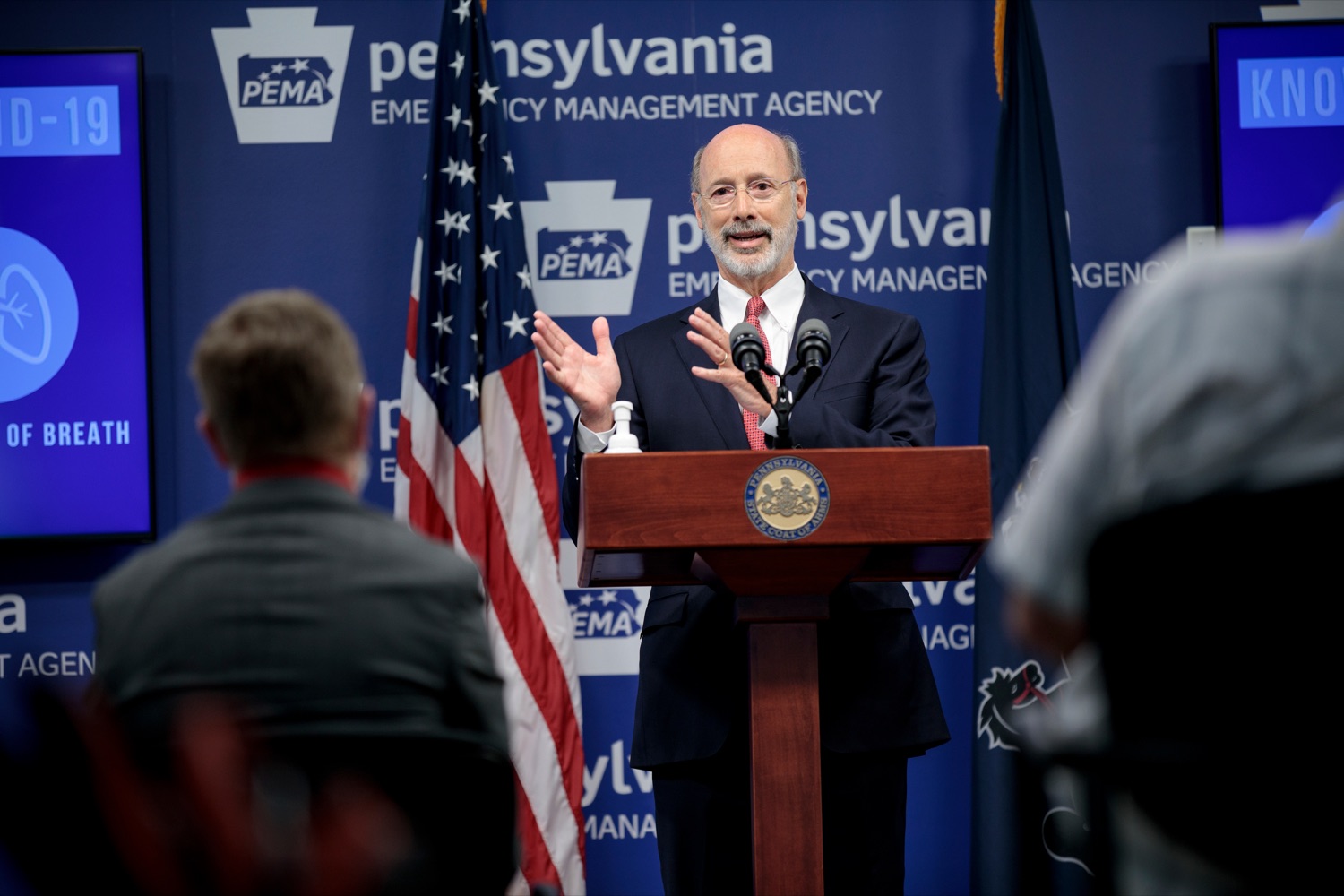
Governor Tom Wolf speaks during a press conference addressing the 2019 Novel Coronavirus (COVID-19) in Pennsylvania, inside PEMA headquarters on Wednesday, June 10, 2020.

BY: TODD BARTLEY, NEWS TALK WMPT, NEWS@TALKWILLIAMSPORT.COM

Wednesday, nearly 24 hours after the PA House and Senate passed HR836 attempting to end the Disaster Declaration issued by Governor Wolf, he held a press conference.

During a heated exchange, Todd Bartley (photo left) of News Talk WMPT challenged Governor Wolf, Health Secretary Levine and General Counsel Schwab on who Pennsylvanians should be listening to for guidance during the crisis.


QUESTION: Governor who are Pennsylvanians supposed to listen to? You’re saying, the secretary and the general counsel are saying listen to us, listen to us. The General Assembly is saying listen to us, listen to us we’re lawmakers and the courts haven’t even been heard from. Who are Pennsylvania’s on a daily basis supposed to listen to in this pandemic, and in this crisis?

Governor Wolf responded: “Me.”

He added, “The Constitution is pretty clear on this, but just to make sure as I said we’re going to take it to the courts to make sure that they’re is not something that were missing here.

Maybe, maybe unbeknownst to me somewhere embedded in the constitution is the right of one branch to arbitrarily decide to do something that is at odds with the Constitution.

I just don’t know where that is.

So, I think the proper thing to do and the careful thing to do is to go to the courts and say how can this happen?”


QUESTION: Are you seeking immediate injunctive relief to keep everything in place?

Governor Wolf: “You want to come in on that? I’m not even sure what our legal strategy is or if you even want to talk about that.”

Gregory Schwab, General Counsel to Governor Wolf: “Again, I’m reluctant to give specifics at this point in time, but that’s certainly as you can assume it’s something that we would be looking at.

And I just want to follow-up on the governor’s comments to that prior question and it goes back to a statement that he made in his remarks about the Secretary of Health’s orders in terms of who should people listen to.

Nothing in the resolution that was passed last evening does anything to disturb the orders that the secretary has issued and we’ve been very careful throughout the covid-19 disaster emergency to issue parallel orders stay-at-home, business closure.

And then based on the additional and separate authority that is granted under the law to the Secretary of Health. She issued orders related to business safety, worker safety, for building safety.

Nothing has changed with respect to those and the phase reopening is based not only on the actions that the governor has taken but also the actions of the Secretary of Health has taken.

So I think that we have the authority lined up from both of them.


Wolf pledges to take legislature to court over effort to end coronavirus emergency order

  • Benjamin Pontz, PA Post

Gov. Tom Wolf on Wednesday pledged to take the legislature to court to resolve a dispute over the standing of a concurrent resolution passed Tuesday night to end the governor’s coronavirus emergency declaration.

The Wolf administration says the state constitution is clear on this matter: For a resolution to have the force of law, it must bear the governor’s signature or have a two-thirds override vote in each chamber of the legislature. That draws on the text of Article III, Section 9 of the state constitution.

Republicans in the General Assembly argue, instead, that Title 35 of the Pennsylvania Consolidated Statutes, from which the governor’s emergency powers are drawn, contain a provision that allows the legislature to terminate a disaster declaration simply by passing a resolution through both chambers, at which point the governor “shall” terminate the declaration.

The legislature does not plan to formally present the resolution to the governor, which would allow him to disapprove (effectively veto) it and send it back for a possible override. Although some Democrats broke ranks in both chambers to support the resolution, neither chamber reached the two-thirds threshold that would be necessary for a veto override.

But unless the resolution is presented to the governor, he cannot formally disapprove of it, Gregory Schwab, the governor’s counsel, said. Until that happens, the administration maintains that the resolution has no legal effect.

“Nothing changes,” said Schwab. “Essentially, the resolution that was passed last evening is meaningless.”

Still, the governor plans to take the issue to court to resolve the ambiguity caused by the diverging messages from the executive and legislative branches. It is not clear how exactly the matter will reach the courts; Schwab repeatedly declined to get into specifics as to the governor’s legal strategy. But the governor was clear that the judicial branch would have a say.

“We’re going to have to take it to the courts to make sure that there’s not something that we’re missing here,” said Wolf. “Maybe, unbeknownst to me, somewhere embedded in the constitution is the right of one branch to arbitrarily decide to do something that is at odds with the constitution. I just don’t know where that is.”

Even if the declaration were to be terminated, Wolf said the central intent of the legislature’s arction — reopening more businesses — would not be accomplished because the orders restricting business activity during the coronavirus epidemic are also nested under authority delegated to the Secretary of Health under a separate statute.

“Ending the disaster declaration would not reopen anything. It just won’t. And anybody who says differently is wrong,” Wolf said.

Ending the resolution would, however, eliminate the legal authority under which the state waived certain licensing requirements, allowed telehealth services across state lines, and opened food distribution sites, Wolf said. It also would eliminate the legal authority under which the governor suspended utility shutoffs and residential evictions.

Until the matter is resolved by the courts, Wolf urged Pennsylvanians to continue to abide by orders issued under the terms of the emergency declaration, including the prohibitions on evictions and utility shutoffs.

Wolf said that the legislature’s action has caused “chaos” and was rooted in “carelessness,” but there ought to be no question about whose directives Pennsylvanians follow until the matter is resolved by the courts.

“Who are Pennsylvanians supposed to listen to during this pandemic, during this crisis?” Wolf was asked.

Wolf responded immediately.

“Me.”

» PA Post is an independent newsroom covering policy and government in Pennsylvania. For more, go to www.papost.org. News Talk WMPT is an affiliate of PA Post.

Wolf Administration Outlines Impacts of Ending Disaster Declaration


Legislature Cannot End Disaster Declaration Unilaterally
Disaster Declaration is Separate from Secretary of Health Business Guideline Orders 

Harrisburg, PA – Today, the Wolf Administration outlined the potential impact of ending the March 6 disaster declaration while clarifying that the legislature cannot end it unilaterally. The disaster declaration aids in speeding up the state’s response to the pandemic and provides protections for businesses, workers and residents. Importantly, ending the disaster declaration would not end any orders issued by the Secretary of Health that set guidelines for business operations.

Last night, the General Assembly voted to end the disaster declaration with many members claiming their actions ended the business guideline orders. That is not true. Not only does any concurrent resolution need to come to the Governor for approval or disapproval, but the disaster declaration is separate from the orders signed by Secretary of Health Dr. Rachel Levine under the Disease Prevention Act that include provisions for business reopening and for worker and building safety. Those orders remain in place. The legislature did nothing to end those.

Rather, the legislature chose to attempt to end the disaster declaration – a measure that would ostensibly end protections passed for businesses, workers, and residents.

If the declaration were to end, these protections would go away:

  • Burdensome eligibility requirements for more than a million Unemployment Compensation claimants would immediately go back into effect, and employers across the commonwealth would no longer receive relief from charges.
  • Certification requirements under the public-school code and child protective services law would end.
  • A school meal eligibility waiver, which has allowed more than 300 meal sites to open for distribution of food to school-age children in need, would end.
  • Telehealth and other health care services provided by out-of-state providers for Pennsylvanians would end.
  • Utility assistance for thousands of families and individuals would end, leaving people without water or electricity.
  • Hospitals and alternative care sites would no longer be able to add capacity or repurpose facilities (i.e., beds) without having to abide by the 60-day notice requirement.
  • License renewal and training requirement suspensions for health care professionals, child care workers, direct care workers, direct support professionals, among other professional groups who provide life sustaining services to our children, seniors, and vulnerable residents would end, meaning all of these workers would need to choose between not returning to work until those credentials could be renewed or trainings completed and the option of returning to work with the understanding that they are practicing out of compliance with Pennsylvania law and regulation, very well opening themselves up to personal liability.
  • PennDOT waivers for commercial motor vehicle weight limitations and permitting requirements for the transport and delivery of agricultural feed, food, and dairy products, fuel, pharmaceuticals, and medical supplies to assist in supply chain challenges would end and motor carriers would be restricted in their ability to directly assist in supporting emergency relief efforts necessary to respond to the pandemic.
  • Mortgage foreclosure and eviction moratoriums that offer protection to vulnerable Pennsylvanians at risk of losing their homes during the pandemic would end.

In addition to these immediate waiver and legislative enactments being removed, ending the disaster declaration also would remove many practical aspects of the state’s response to this disaster, including the authority to activate the National Guard to help with nursing homes; deploying commonwealth personnel, services and distributing supplies and equipment; implementing emergency funding; suspending rules and regulations that would hinder or delay necessary action in coping with the emergency; and using all available resources of the commonwealth government and its political subdivisions to deal with the emergency.

The state could also lose federal public and individual disaster assistance, and any additional state funding sources available through transfer of unused General Fund dollars.

During a state of emergency declared by the governor, commonwealth agencies and departments may implement their emergency assignments without regard to procedures required by other laws pertaining to performing their work, entering into contracts, purchasing supplies and equipment, and employing temporary workers.