Online Grocery Purchasing for SNAP Recipients Now Available, Retailers Encouraged to Join Program

Harrisburg, PA – The Department of Human Services (DHS) today announced that the system changes necessary to implement the pilot program that lets recipients of the Supplemental Nutrition Assistance Program (SNAP) purchase groceries online through participating retailers have been completed, and online grocery purchasing is now active at approved retailers.

“SNAP recipients in Pennsylvania have not had the flexibility to use online purchasing for grocery delivery or for prepayment of curbside pick-up, potentially putting their health and safety at risk during this health crisis. We are proud to announce that that changes today. We are glad to launch this pilot program to allow us to expand flexibility to SNAP recipients looking to utilize online grocery purchasing to support social distancing and COVID-19 mitigation efforts,” said DHS Secretary Teresa Miller. “No one should be in the position of jeopardizing their health to get groceries for their family. I encourage retailers across the commonwealth to reach out to Food and Nutrition Services (FNS) and join this program.”

The pilot program currently includes three approved retailers: Amazon, Walmart, and ShopRite. Only eligible food items normally paid for by SNAP will be able to be purchased from these retailers online with SNAP benefits; delivery fees, driver tips, and other associated charges may not be paid for with SNAP benefits. Due to the expedited timeframe to implement, this initiative does not include the ability to transact Cash Assistance benefits using the EBT card.  Therefore, individuals will need to use another method of payment, such as a pre-paid debit card, to cover non-allowable fees.

A fourth retailer, The Fresh Grocer, was approved by the federal government to participate in the program, and once necessary system changes are implemented, they too will begin accepting online SNAP payments. Retailers that are interested in participating must contact FNS to review the requirements to be added to the program.

Retailers that do not wish to join the pilot program can still offer delivery or pick-up flexibility options for SNAP recipients by using mobile EBT processing equipment that would allow customers to pay with SNAP when groceries are delivered or picked up. Farmers markets may be able to receive this processing equipment at no cost through a grant opportunity provided by DHS.

DHS is continuing to process applications for SNAP and encourages people and families who need assistance to apply online at www.compass.state.pa.us. All SNAP applications are screened for expedited services criteria which can accelerate processing time for those with emergency needs. Pennsylvanians who need help feeding themselves or their family can also find and contact their local food bank or pantry through Feeding Pennsylvania and Hunger-Free Pennsylvania to access food resources in their community

Visit pa.gov for a “Responding to COVID-19” guide or the Pennsylvania Department of Health’s dedicated Coronavirus webpage for the most up-to-date information regarding COVID-19.

Guidance to DHS providers related to COVID-19 is available here.
Wolf Admin: Long-Term and Congregate Care Restrictions Will Remain in Place to Protect Vulnerable Populations as Pennsylvania Reopens

Harrisburg, PA – The Pennsylvania departments of Health and Human Services issued guidance for nursing homes, personal care homes, and other long-term and congregate care facilities as counties enter the green phase of the Governor’s Process to Reopen Pennsylvania. To further prevent outbreaks within these vulnerable populations, ongoing restrictions in long-term and congregate care facilities will remain in place at least 28 days after the respective facility’s county enters the green phase.

“We continue to take a careful, measured approach to ensuring that Pennsylvanians can resume work and normal routines safely – especially in our nursing home facilities across Pennsylvania,” Secretary of Health Dr. Levine said. “We need to continue this mitigation effort to make sure that our most vulnerable individuals remain safe. We encourage alternative means of communication for residents to stay in touch with their family, friends, community members, and advocates while we take necessary health and safety precautions.”

On March 18, the department issued guidance for nursing home facilities on COVID-19 mitigation. This guidance required visitor limitations, personnel restrictions, and other measures to reduce the spread of COVID-19 in nursing facilities. This guidance has since been updated on May 12.

“We must remain vigilant and be deliberate about our actions even as we begin to reopen. Green does not mean all clear for anyone, and COVID-19 is still a threat, especially for those who are medically fragile and vulnerable. This virus is not gone, and mitigation efforts are still necessary to keep people safe,” said DHS Secretary Teresa Miller. “We understand that for residents of long-term care facilities and their families, these restrictions have been an isolating burden during a difficult time, but our hope is that this careful approach will help these facilities avoid an outbreak and keep residents, staff, and their families safe.”

DHS has issued guidance restricting visitation to its licensed intermediate care facilities, assisted living residences as well as DHS’ 17 state-run facilities, which include state centers, state hospitals, youth development centers, and youth forestry camps. Individuals served by these facilities often have chronic medical conditions and are at a higher risk of complications from COVID-19, so caution and care must be taken to keep residents and staff at these facilities safe from the virus. Guidance to DHS providers is available here.

DHS has worked with licensed providers and staff at state-run facilities to encourage and facilitate virtual visits and communication to maintain connection between residents and families while they are unable to be together. Unless otherwise indicated by the individual, the expectation is that communication with family and friends is supported on a regular and routine basis for each individual. Means of safe visitation include:

  • Arranging a meeting that occurs between an individual or family/friends viewing each other through a window or glass door, so that social distancing guidelines can be followed.
  • Using technology such as FaceTime, Skype, Zoom meetings, Facebook, Messenger, etc.
  • Promoting communication through telephone calls, email, writing letters, texting, sending photographs or videos, or the use of virtual assistant technology (ex. Amazon’s Alexa or Google Home).

Following the guidance from the Centers for Medicare and Medicaid Services, these restrictions will be among the last restrictions eased to ensure resident health and safety during the COVID-19 pandemic.

To further develop a well-informed, manageable plan that ensures a measured approach for the safe return to activities, visitation, and other events for residents of nursing home facilities, the department is conferring with stakeholders including the state’s ombudsman, representatives from skilled nursing care facilities, nursing home associations, other government agencies, and academia. Upon completion of that process, the department will issue guidance that amends the restrictions currently in place.

Since the beginning of the COVID-19 pandemic, the Department of Aging Ombudsman has served as a source of encouragement and connection for families who are trying to reach loved ones, because, by the very nature of their personalized advocacy approach, they’ve been very successful in working with nursing homes to develop connections in accordance with a family’s needs and a facility’s procedures/capabilities.

Family and friends who are unable to see loved ones living in long-term care facilities because of the COVID-19 emergency may struggle with changes in protocol, rights and policies. The Pennsylvania Long-Term Care Ombudsman Program is available to help with a new statewide resource called Virtual Family Council.

The Ombudsman Program has a ground force of 73 local ombudsmen in communities across Pennsylvania, advocating and empowering on a case-by-case basis for long-term care residents to resolve complaints and issues. The number to call for assistance from a local representative is 717-783-8975.

The Wolf Administration has taken a three-pillar approach to protecting the vulnerable residents living in long-term living settings from COVID-19:

  • Ensuring resident safety through testing, education and resources;
  • Preventing and mitigating outbreaks; and
  • Working in partnership with state agencies, local health departments and long-term care facility operators.

The Department of Health distributed over 1,812 shipments of personal protective equipment to all long-term care facilities in Pennsylvania. Additionally, the department continues to work with ECRI as they provide technical assistance and our Healthcare Acquired Infection (HAI) team to further assist and remain connected with the nursing homes in order to best assist their needs.

For additional resources regarding COVID-19 and nursing homes in Pennsylvania, please visit the department’s COVID-19 Information for Nursing Homes webpage.

The Wolf Administration stresses the role Pennsylvanians play in helping to reduce the spread of COVID-19:

  • Wash your hands with soap and water for at least 20 seconds or use hand sanitizer if soap and water are not available.
  • Cover any coughs or sneezes with your elbow, not your hands.
  • Clean surfaces frequently.
  • Stay home to avoid spreading COVID-19, especially if you are unwell.
  • If you must go out for a life-sustaining reason, please wear a mask.

Updated Coronavirus Links: Press Releases, State Lab Photos, Graphics

All Pennsylvania residents are encouraged to sign up for AlertPA, a text notification system for health, weather, and other important alerts like COVID-19 updates from commonwealth agencies. Residents can sign up online at www.ready.pa.gov/BeInformed/Signup-For-Alerts.

Sec. Levine responds to News Talk WMPT with Yes on vaccine being cornerstone to move past Green Phase

During the Wednesday press availability Todd Bartley of News Talk WMPT was in attendance at the PEMA building in Harrisburg and posed a question to the Secretary of Health regarding what life after the Green Phase will look like and what thresholds will be used in determining that status.

QUESTION: Secretary, you mentioned the normal after the Green phase, what does that look like?  What metrics or thresholds will need to be achieved and will scorecard coming out on Friday reflect that?

“Well the scorecard will be coming out what counties need to from yellow to green.

The new normal is continue and that means wearing masks.

We are going to want people to wear masks for the foreseeable future, when they go outside and going to encounter people.

We want people to wash their hands really well and pay attention to that for the foreseeable future. 

We want people to use hand sanitizer liberally for the foreseeable future.

We want people as much as possible to continue to practice social distancing for the foreseeable future.

So that’s what the Governor means by the new normal as we were saying before, COVID-19 is not gone and we do not have anywhere near herd immunity really anywhere in the world.

There have been some surveillance testing using antibodies.

There’s some questions about antibody tests and looking at antibody levels and there is no place in the world that has herd immunity.

We’re going to need to continue to be vigilant about the risk of COVID-19 for the foreseeable future; really until there is a safe and effective vaccine that can be distributed.”

QUESTION: As a follow-up, is the vaccine a cornerstone of what you’re looking for as a threshold?

Secretary Levine added, “Yes. So, the way to get through this without an enormous number of cases and loss of life is through a safe and effective vaccine and I know the federal government is working really hard on promoting that.”

On Friday, it is anticipated Governor Wolf will join Secretary Levine for a press availability and News Talk WMPT will once again be in attendance at the PEMA building in Harrisburg covering the event.


Pennsylvania Patriots Radio Shows now available online

The Pennsylvania Patriots Radio Shows from May 16 and may 30 are now available online. PPR is hosted by Carlos Saldivia and Robert Noerr.

The guests on May 16 were State Senator Doug Mastriano and Diane Menio, executive director of the Center for Advocacy for the Rights & Interests of the Elderly.


On Saturday May 30, Pennsylvania Patriots Radio was joined in the 11 a.m. hour by Lycoming County Commissioner Tony Mussare. He joined the program to discuss the upcoming Green status issued by Governor Wolf for June 5.


The shows include regular contributor PAPBA award winning broadcaster Todd Bartley who serves as General Manager of News Talk WMPT and talkwilliamsport.com.

To contact the show e-mail news@talkwilliamsport.com.

Pennsylvania Patriots Radio precedes the Marc Scaringi Show which airs Saturday at 1 p.m.

News Talk WMPT asks Sec. Levine about Gov. Wolf marching in violation of Yellow Phase Orders

During the Wednesday press availability Todd Bartley of News Talk WMPT was in attendance at the PEMA building in Harrisburg and posed a question to the Secretary of Health regarding Governor Wolf marching in a protest in direct violation of Yellow Phase orders.

QUESTION: Secretary, Dauphin County just moved to yellow on May 29th which means no large gatherings and apparently there is a march going on that has more than 200 people in it today in Dauphin County. Can you clarify the administration’s position on May 11th business owners were called cowards for wanting to reopen their businesses and today the Governor is actually marching in that, (HM) is that not in violation of your order and his order for large gatherings?

Secretary Levine responded; “Well, so we have and the Governor has always said that people have the right to protest and to demonstrate and the the right of free speech.

And so overall, we want, large gatherings such as, such as maybe a party or some type of concert or something to be under 250 people.

But we are not restricting people’s right to protest there are obviously significant social issues that are present that people feel that they need to have a voice and the Governor is always supportive of that and is participating in.”


News Talk WMPT has learned from Dauphin County officials the protest included nearly 500 people.

In May as noted above, News Talk WMPT published “Congressman Keller blasts Gov. Wolf’s threat to withhold funding and protections from PA counties and businesses”

Keller noted on Wednesday, after seeing Governor Wolf in the protest march and comments made by Secretary Levine, “Gov. Wolf said hardworking Pennsylvanians protesting for their right to earn a living were “cowardly.” He threatened to withhold taxpayer funds from those who didn’t social distance. Today, he’s literally walking arm-in-arm with protesters. His hypocrisy knows no end.”

On Friday, it is anticipated Governor Wolf will join Secretary Levine for a press availability and News Talk WMPT will once again be in attendance at the PEMA building in Harrisburg covering the event.

DOH Distributes Fourth Shipment of Drug to Help Treat COVID-19 Patients in Hospitals

Harrisburg, PA – The Department of Health distributed the fourth shipment of the investigational antiviral medication, remdesivir, to treat patients in the hospital with COVID-19. Yesterday, 4,400 doses of medication were sent to 73 hospitals. The federal government distributed the shipment to the department on Wednesday, June 3 and this entire allotment has been shipped to Pennsylvania hospitals.

“The department is working to give our hospitals every opportunity to treat patients with COVID-19,” Secretary of Health Dr. Rachel Levine said. “It is important to note that there is limited information on the safety and effectiveness of using remdesivir to treat people in the hospital with COVID-19. However, it was shown in a clinical trial to shorten the recovery time in some people, which is why the Food and Drug Administration (FDA) has authorized the emergency use of the medication for treatment.”

The Department of Health first distributed 1,200 doses of the medication to 51 hospitals across Pennsylvania on May 12. A second round of 7,938 doses was sent to 79 hospitals on May 15 and May 18, and a third round was distributed to 81 hospitals on May 22. The hospitals that have received these shipments were determined based on the number of COVID-19 patients at the hospital over a recent seven-day period, and the severity of the illness of those patients based on whether they are on a ventilator. The department will continue to work with its federal partners to acquire more doses of this medication to serve more patients across Pennsylvania.

Remdesivir is given to a patient through an IV once per day for up to 10 days, depending on how critically ill the patient is. According to the FDA, remdesivir may help decrease the amount of coronavirus in the body, which may lead to a faster recovery.

Symptoms of COVID-19 can include:

  • Fever
  • Cough
  • Shortness of breath or difficulty breathing
  • Diarrhea
  • Chills
  • Repeating shaking with chills
  • Muscle pain
  • Headache
  • Sore throat
  • New loss of taste or smell

Symptoms may appear in as few as two days or as long as 14 days after exposure. Reported illnesses have ranged from people with little to no symptoms to people being severely ill and dying.

As of 12:00 a.m., June 4, there were 73,942 positive cases of COVID-19 statewide in 67 counties and 5,817 confirmed deaths. Most of the patients hospitalized are 65 or older, and most of the deaths have occurred in patients 65 and older. There have been no pediatric deaths to date. More data is available here.

For the latest information for individuals, families, businesses and schools, visit “Responding to COVID-19” on pa.gov.

The Wolf Administration stresses the role Pennsylvanians play in helping to reduce the spread of COVID-19:

  • Wash your hands with soap and water for at least 20 seconds or use hand sanitizer if soap and water are not available.
  • Cover any coughs or sneezes with your elbow, not your hands.
  • Clean surfaces frequently.
  • Stay home to avoid spreading COVID-19, especially if you are unwell.
  • If you must go out for a life-sustaining reason, please wear a mask.

Updated Coronavirus Links: Press Releases, State Lab Photos, Graphics

All Pennsylvania residents are encouraged to sign up for AlertPA, a text notification system for health, weather, and other important alerts like COVID-19 updates from commonwealth agencies. Residents can sign up online at www.ready.pa.gov/BeInformed/Signup-For-Alerts.

UPMC Data Show COVID-19 is Increasingly Rare; Efforts to Protect Elderly are Working

By: Allison Hydzik

As most of the communities UPMC serves prepare to move to green – the least restrictive of Pennsylvania’s COVID-19 reopening phases – the health system today provided an update on what its data are showing and plans to keep patients safe.  

UPMC doctors also shared that the health system’s experts drafted recently passed state legislation to help long-term care providers prevent the spread of COVID-19 in their facilities, which house elderly people who are most vulnerable to the disease.  


“Protecting the elderly is a critically important component of safely reopening society,” said Dr. David A. Nacechief medical officer of UPMC Senior Communities, at a UPMC press briefing. “UPMC is sharing what we’ve learned so that long-term care facilities in our regions and nationwide can replicate our success and prevent untimely deaths.” 

None of the 3,000 residents of the more than 30 UPMC Senior Communities has tested positive for COVID-19. UPMC recently began testing residents without symptoms and still has not detected the virus. The health system is also introducing antibody testing to its staff so they can learn if they ever had the virus without knowing it. 

UPMC employees prepare COVID-19 antibody tests.

UPMC employees prepare COVID-19 antibody tests.

“We do not want to passively wait for the virus to appear – we need to hunt it down,” said Nace, who, as a UPMC Senior Communities employee, recently received the antibody testing and is awaiting results. 

Dr. Donald Yealy, chair of emergency medicine at UPMC and the University of Pittsburgh, said that UPMC’s testing of patients and staff outside of long-term care facilities has also provided reassuring results. Less than 4% of all tests and only 0.2% of tests in asymptomatic patients are coming back positive, indicating that the virus is less prevalent in the communities UPMC serves.  

UPMC never stopped providing patients with necessary, essential care, though only about half of the normally expected number of patients were visiting the health system’s hospitals for care during the height of public concern over the virus. In the past month, UPMC returned to nearly 100% of its inpatient pre-COVID care levels.  

“The rapid return of patients to our hospitals and outpatient sites reflects the pent-up demand for care at UPMC,” Yealy said. “And we are providing this care in the cleanest and safest hospitals and outpatient sites with the best infection prevention techniques you’ll find anywhere.” 

Reopening Phase Orders Updated to Include 10 Additional Counties Moving to Yellow and 16 to Green on June 5

Harrisburg, PA – Governor Tom Wolf and Secretary of Health Dr. Rachel Levine today signed amended yellow phase orders to include 10 counties moving to the yellow phase at 12:01 a.m. tomorrow, June 5. The counties include Berks, Bucks, Chester, Delaware, Lackawanna, Lancaster, Lehigh, Northampton, Montgomery and Philadelphia.

In addition, the governor and the secretary signed amended green phase orders to include 16 counties moving to the green phase at 12:01 a.m. tomorrow. The counties include Allegheny, Armstrong, Bedford, Blair, Butler, Cambria, Clinton, Fayette, Fulton, Greene, Indiana, Lycoming, Mercer, Somerset, Washington and Westmoreland.

With these orders, there are no counties in the red phase. In total, on June 5, there will be 34 counties in the green phase and 33 in the yellow phase.

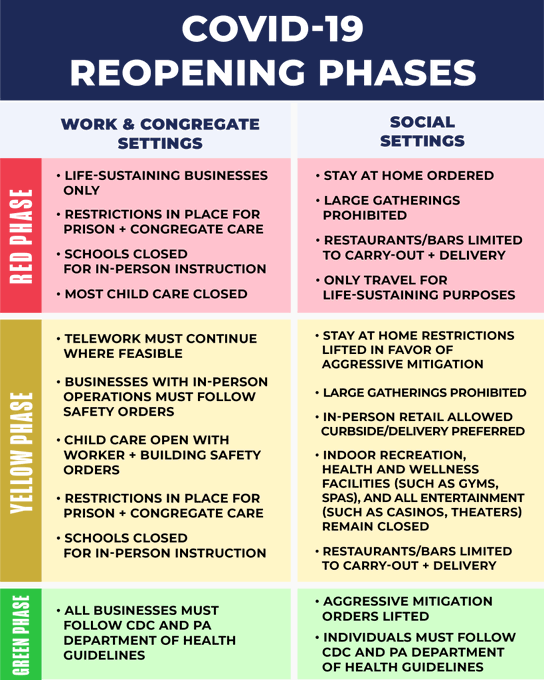
Gov. Wolf’s Process to Reopen Pennsylvania includes details of each phase of reopening.

Yellow Phase

As regions or counties move into the yellow phase, some restrictions on work and social interaction will ease while others, such as closures of schools, gyms, and other indoor recreation centers, hair and nail salons, as well as limitations around large gatherings, remain in place.

The purpose of this phase is to begin to power back up the economy while keeping a close eye on the public health data to ensure the spread of disease remains contained to the greatest extent possible.

Work and Congregate Setting Restrictions

Social Restrictions

  • Stay-at-Home Order Lifted for Aggressive Mitigation
  • Large Gatherings of More than 25 Prohibited
  • In-Person Retail Allowable, Curbside and Delivery Preferable
  • Indoor Recreation, Health and Wellness Facilities and Personal Care Services (such as gyms, spas, hair salons, nail salons and other entities that provide massage therapy), and all Entertainment (such as casinos, theaters) Remain Closed
  • Restaurants and Bars May Open Outdoor Dining, in Addition to Carry-Out and Delivery (effective 6/5/2020)

Green Phase

After a county transitions to the yellow phase, we will closely monitor for increased risk, such as significant outbreaks. If overall risk remains mitigated for 14 days, we will transition the county to the green phase.

The green phase eases most restrictions by lifting the stay-at-home and business closure orders to allow the economy to strategically reopen while continuing to prioritize public health.

While this phase will facilitate a return to a “new normal,” it will be equally important to continue to monitor public health indicators and adjust orders and restrictions as necessary to ensure the spread of disease remains at a minimum.

Work and Congregate Settings Restrictions

  • Continued Telework Strongly Encouraged
  • Businesses with In-Person Operations Must Follow Updated Business and Building Safety Requirements
  • All Businesses Operating at 50% Occupancy in the Yellow Phase May Increase to 75% Occupancy
  • Child Care May Open Complying with Guidance
  • Congregate Care Restrictions in Place
  • Prison and Hospital Restrictions Determined by Individual Facilities
  • Schools Subject to CDC and Commonwealth Guidance

Social Restrictions

  • Large Gatherings of More Than 250 Prohibited
  • Restaurants and Bars Open at 50% Occupancy
  • Personal Care Services (including hair salons and barbershops) Open at 50% Occupancy and by Appointment Only
  • Indoor Recreation, Health and Wellness Facilities, and Personal Care Services (such as gyms and spas) Open at 50% Occupancy with Appointments Strongly Encouraged
  • All Entertainment (such as casinos, theaters, and shopping malls) Open at 50% Occupancy
  • Construction Activity May Return to Full Capacity with Continued Implementation of Protocols

The latest business guidance can be found here.

The Governor’s amended yellow phase order can be found here.

The Governor’s amended green phase order can be found here.

The Secretary of Health’s amended yellow phase order can be found here.

The Secretary of Health’s amended green phase order can be found here.

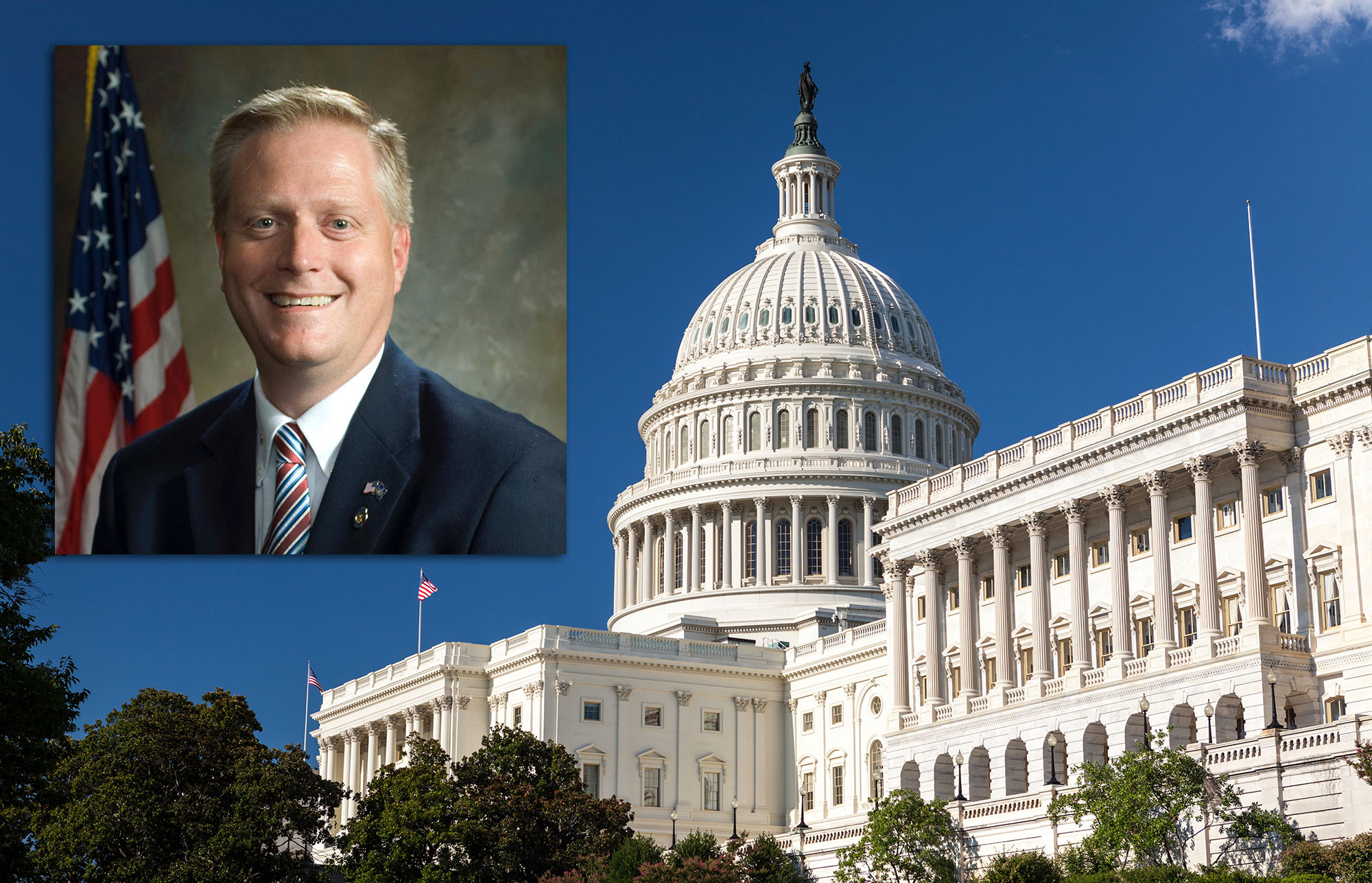
Congressman Fred Keller applauds passage of Paycheck Protection Flexibility Act

Keller-supported bill headed for President Trump’s signature

Washington, D.C. – Congressman Fred Keller (R-PA) on Thursday applauded the Senate passage of H.R. 7010—The Paycheck Protection Flexibility Act. The bipartisan legislation passed the House of Representatives last week with Congressman Keller’s support and now heads to the President for his signature.

The legislation, among other things:

  • Extends the forgiveness period to 24 weeks.
  • Replaces the 75/25 payroll cost use rule with a 60/40 rule.
  • Provides that all new Paycheck Protection loans will receive a 5-year maturity. Existing loans will remain at a 2-year maturity.
  • Allows businesses that receive forgiveness to also receive payroll tax deferment.
  • Ensures small businesses will not be penalized by high unemployment benefits.
  • Creates a safe harbor for businesses that are required to open only at 50 percent capacity.

Through the end of May, Pennsylvania small businesses have received over $20 billion in Paycheck Protection Program loans.

In response, Congressman Fred Keller (R-PA) made the following statement:

“The Paycheck Protection Program has been one of the most crucial tools authorized as part of the federal government’s response to COVID-19. We have heard countless times how this program has saved small businesses on the verge of closing and kept employees hired so they can support their families during this uncertain time.

“While helpful to many, small businesses and lenders have almost universally called for more flexibility in the program to ensure Paycheck Protection loans can be used most effectively to meet their intended end, which is to keep employees hired and help small businesses weather this pandemic.

“I was proud to support the Paycheck Protection Flexibility Act in the House and will be glad to see President Trump sign this important measure into law for the benefit of small businesses and employees across the country.”

Dept. of Aging Joins AARP to Support Family Connections in Long-Term Care Facilities

Harrisburg, PA – The Pennsylvania Department of Aging’s Office of Long-Term Care Ombudsman announced it is partnering with AARP Pennsylvania to offer communication devices to long-term care facilities that will help residents increase contact with their family and friends.

With support from the Pennsylvania Association of Area Agencies on Aging, this pilot program will provide cell phones and tablets to 46 skilled nursing facilities in 40 counties where resident advocates known as Pennsylvania Empowered Expert Residents (PEERs) or a facility’s staff member had expressed a need for phones/tablets and have made a commitment to support the appropriate use of the devices. Nineteen devices will go to facilities identified as Special Focus Facilities by the Centers for Medicare and Medicaid Services (CMS) and/or are operating under provisional licenses.

“As restrictions from the COVID-19 emergency continue, concerned family members want to maintain contact and stay connected with their loved ones in long-term care facilities. To support facilities having limited options or challenges in helping residents to stay in touch, the Department of Aging is pleased to partner with AARP to provide this technology to help residents stay engaged and hopefully avoid feelings of depression and social isolation,” said Aging Secretary Robert Torres.

The Department and AARP will distribute the activated devices to the targeted facilities utilizing PEERs, resident councils and other resident leaders and nursing home activities directors to implement this project.

“The COVID-19 pandemic has forced visitation bans at long-term care facilities across Pennsylvania, effectively isolating residents from friends and family,” said Bill Johnston-Walsh, AARP Pennsylvania state director. “AARP is very pleased to be working with the Department of Aging to make cell phones and other technology available to help vulnerable older adults maintain critical lines of communication during this crisis.”

Two organizations that advocate for older Pennsylvanians say they are in full support of this partnership’s pilot program.

“We believe this is an excellent initiative that will help residents connect with family at a time when it is unsafe to visit,” said Anne Henry, senior vice president and chief government affairs officer of LeadingAge PA. “We appreciate the leadership of the PA Department of Aging and AARP and look forward to working with them to implement this important program.”

“For the past several months, the caregivers in Pennsylvania’s nursing homes, assisted living communities and personal care homes have gone to extraordinary lengths to ensure the health and wellbeing of the residents entrusted to their care,” said Zach Shamberg, president and CEO of the Pennsylvania Health Care Association. “While a number of providers have already taken steps to offer alternative means of communication to keep their residents connected to family and friends, we’re thrilled this partnership will expand these opportunities to more facilities and communities across the commonwealth.”

With 73 local ombudsmen in communities across Pennsylvania, the Office of the Long-Term Care Ombudsman advocates and empowers long-term care residents to resolve complaints and issues on a case-by-case basis. During the COVID-19 pandemic, the program has served as a source of encouragement and connection for families that are trying to reach loved ones in long-term care facilities despite challenges in doing so.

“The Office of Long-Term Care Ombudsman remains committed to assisting residents in facilities and their families with staying in touch through this pandemic. We understand the frustration and heartbreak families are facing, and we want to ensure they are aware of how their loved ones are doing and that they are safe,” said Margaret Barajas, state long-term care ombudsman. “This partnership with AARP is a great opportunity to get communication devices into long-term care facilities to give families and their loved ones some peace of mind.”

Volunteers that support the Office of Long-Term Care Ombudsman recently launched a new resource called the Virtual Family Council, which offers families a chance to virtually connect with a local ombudsman and other experts to ask questions and discuss protocols, rights and procedures for their loved ones in long-term care facilities. The meetings are held weekly and do not address specific issues regarding a resident or a facility. Anyone interested in joining the meetings can email jarotz@pa.gov and indicate “Virtual Family Council” in the subject line. They will receive an automatic email reply with instructions on how to connect and the link for the meetings.

Learn more about the LTC ombudsman and various programs offered by the Pennsylvania Department of Aging here.