Gov. Wolf announced $225 Million Discretionary CARES ACT funding for small business he previously threatened to withhold

BY: TODD BARTLEY, NEWS TALK WMPT, NEWS@TALKWILLIAMSPORT.COM

On Monday, Governor Wolf announced a $225 Million Grant Program for Small Businesses.

“As we continue to navigate the COVID-19 pandemic and shift our focus toward reopening our commonwealth, we need to help all Pennsylvanians recover. We need to provide assistance for those who were hurt by the pandemic and the resulting economic downturn,” Gov. Wolf said. “This new program will provide direct support to impacted businesses to cover operating expenses during the shutdown and the transition to reopening.”

The funding was developed in partnership with state lawmakers and allocated through the recently enacted state budget, which included $2.6 billion in federal stimulus funds through the Coronavirus Aid, Relief, and Economic Security (CARES) Act, of which $225 million was earmarked for relief for small businesses.

The Department of Community and Economic Development (DCED) will distribute the funds to the Community Development Financial Institutions (CDFIs), which will then administer the funding in the form of grants.

Eligible businesses will be able to use the grants to cover operating expenses during the shutdown and transition to re-opening, and for technical assistance including training and guidance for business owners as they stabilize and relaunch their businesses.

The funds will be available through three programs:

  • $100 million for the Main Street Business Revitalization Program for small businesses that experienced loss as a result of the governor’s March 19, 2020 order relating to the closure of all non-life-sustaining businesses and have or will incur costs to adapt to new business operations related to COVID-19;
  • $100 million for the Historically Disadvantaged Business Revitalization Program for small businesses that experienced loss as a result of the business closure order, have or will incur costs to adapt to new business operations related to COVID-19, and in which socially and economically disadvantaged individuals own at least a 51 percent interest and also control management and daily business operations.
  • $25 million for the Loan Payment Deferment and Loss Reserve Program, which will allow the CDFIs the opportunity to offer forbearance and payment relief for existing portfolio businesses that are struggling due to the impact of COVID, as well as shore up the financial position of the CDFIs that are experiencing significant increased defaults in their existing loan portfolios.

News Talk WMPT reached Lyndsay Kensinger, Press Secretary for Governor Wolf regarding where these funds came from.

QUESTION: Are these discretionary Coronavirus Aid, Relief, and Economic Security (CARES) Act funds?

Kensinger responded, “Yes.”


On May 11, 2020, Governor Wolf held a press conference in response to a number of counties and closed businesses making public their desire to move to Yellow or Green phases ahead of his orders.

News Talk WMPT covered the event on May 11, 2020 when Wolf made his speech; BREAKING NEWS: Gov. Wolf speechless in response to News Talk WMPT question on the USSC case, (video link).

Remarks delivered by Governor Wolf on May 11 are included in part below.

“These heroic acts deserve to be met not by surrendering, but by staying the course. And that’s what I intend to do.

To those politicians who decide to cave in to this coronavirus, they need to understand the consequences of their cowardly act.

The funding we have put aside to help with fighting this crisis will go to the folks who are doing their part. That includes our CARES Act funding, which will be used to support counties that are following the orders to prevent the spread, and the medical communities who are treating patients. However, other discretionary funding won’t go to counties that put us all at risk by operating illegally.

To the politicians urging businesses to risk the lives of their customers or their employees by opening prematurely: they need to understand that they are engaging in behavior that is both selfish and unsafe.

As News Talk WMPT reported that same day, Congressman Keller blasts Gov. Wolf’s threat to withhold funding and protections from PA counties and businesses. Keller led his response with “Trying to feed your family is not ‘cowardly.”

Keller went onto say: “The vast majority of Pennsylvanians rely on their jobs to put food on the table and pay their bills. Because of Gov. Wolf’s prolonged shutdown order, nearly 2 million Pennsylvanians, or 26 percent of our state’s workforce, are unemployed, and overdose and suicide deaths are rising. Pennsylvanians have shown they can safely shop and work in mega-retailers while the Governor unilaterally keeps small businesses closed and is now threatening them if they re-open. Despite what Gov. Wolf believes, Pennsylvania’s small business owners and workers are smart enough to operate safely and feed their families.”

Governor Wolf in his prepared remarks did not call business owners “cowards”. 

Instead, he stated the following:

“To business owners: These politicians put you at risk of losing your health department certificate. They put you business owners at risk of losing your liquor license. They put you business owners at risk of losing your certificate of occupancy. All of these depend upon your doing everything you can to keep your patrons safe. And by opening before the evidence suggests you should, you are taking undue risks with the safety of your customers.

That is not only morally wrong. It’s also very bad business.

Businesses that do follow the whims of local politicians and ignore the law and the welfare of their customers will probably find themselves uninsured. Because, insurance does not cover things that happen to businesses breaking the law.”

As Governor Wolf noted in his answers to News Talk WMPT on Monday, it is not yet known if this $225 million round of funding will be the only round available to Pennsylvania businesses.
Governor Wolf on the issues of race relations: “There are two Pennsylvanias”

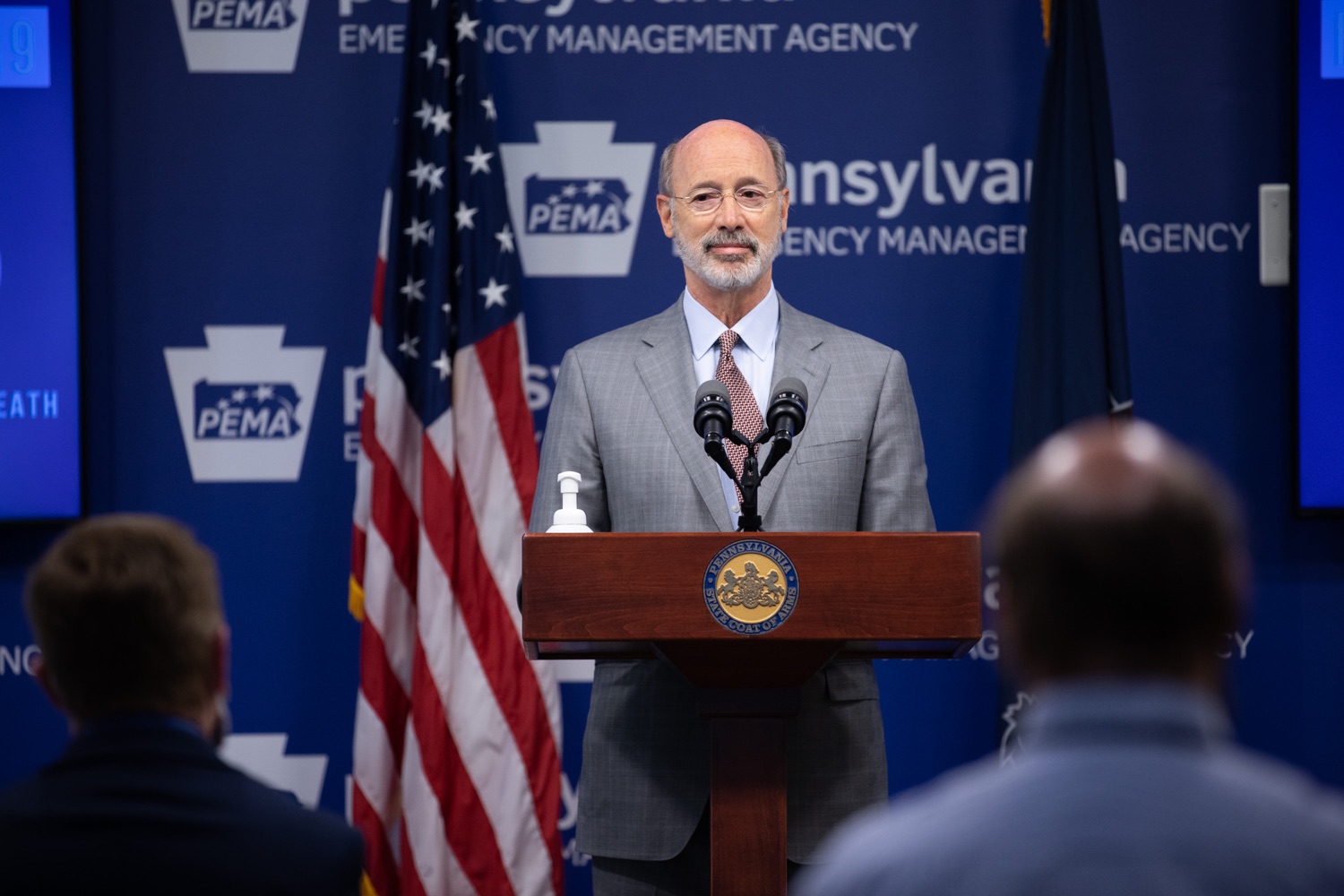
Pennsylvania Governor Tom Wolf answering questions from the press. Governor Tom Wolf today announced a $225 million statewide grant program to support small businesses that were impacted by the COVID-19 public health crisis and subsequent business closure order. Harrisburg, PA — June 8, 2020

During a Monday afternoon press conference Governor Tom Wolf announced a $225 million statewide grant program to support small businesses that were impacted by the COVID-19 public health crisis and subsequent business closure order.

During the press conference, Todd Bartley of News Talk WMPT (left side of photo) posed the following question to Governor Wolf regarding race relations going forward.

QUESTION: Governor, what is your best advice to Pennsylvanians in finding mutual understanding on the issues of race relations going forward?

“I think we have to start by making sure that we’re not in denial.

That we’ve got to recognize that there are two Pennsylvanias out there.

When you look at the criminal justice system there are two Pennsylvanias there is one Pennsylvania for you if you are white and one of you’re not.

If you look at the prison system there’s two Pennsylvanias

If you look at the employment situation, unemployment rate, look at health care there are two Pennsylvanias.

So, I think we need to get out of denial and recognize that we’re, we have a problem here and that it a problem that obviously effects people of color.

But it effects all of the rest of us, because it says something about the society and the political system and the economy that we operate in that it is not operarting on all cylinders unless everybody is afforded an equal opportunity; then our system is not working.

So we all have a self interest a vested interest in making this as fair a society as we can make it.

We’re not there yet.

News Talk WMPT and talkwilliamsport.com will be in attendance on Wednesday for the press availability with Governor Wolf and Secretary Levine in Harrisburg.

UPDATE: 493 Positives Bring PA Total to 76,436 with 6,014 total deaths on Tuesday

Department of Health Provides Update on COVID-19,

493 Positives Bring Statewide Total to 76,436

Harrisburg, PA – The Pennsylvania Department of Health today confirmed as of 12:00 a.m., June 9, that there are 493 additional positive cases of COVID-19, bringing the statewide total to 76,436. All 67 counties in Pennsylvania have cases of COVID-19.

There are 6,014 total deaths attributed to COVID-19, an increase of 61 new deaths. County-specific information and a statewide map are available here.

“With more than half of the state now in the green phase of the process to reopen, it is essential that we continue to take precautions to protect against COVID-19,” Secretary of Health Dr. Rachel Levine said. “Each of us has a responsibility to protect ourselves, our loved ones and others by wearing a mask, maintaining social distancing and washing our hands frequently. Together we can protect our most vulnerable Pennsylvanians, our essential workers and our healthcare system.”

There are 625 patients who have a positive serology test and either COVID-19 symptoms or a high-risk exposure, which are considered probable cases and not confirmed cases. There are 459,248 patients who have tested negative to date. Of the patients who have tested positive to date the age breakdown is as follows:

  • Nearly 1% are ages 0-4;
  • Nearly 1% are ages 5-12;
  • Nearly 2% are ages 13-18;
  • 6% are ages 19-24;
  • Nearly 37% are ages 25-49;
  • 25% are ages 50-64; and
  • 28% are ages 65 or older.

Most of the patients hospitalized are ages 65 or older, and most of the deaths have occurred in patients 65 or older. More data is available here.

In nursing and personal care homes, there are 16,247 resident cases of COVID-19, and 2,824 cases among employees, for a total of 19,071 at 618 distinct facilities in 45 counties. Out of our total deaths, 4,117 have occurred in residents from nursing or personal care facilities. A county breakdown can be found here.

Approximately 5,796 of our total cases are in health care workers.

For the latest information for individuals, families, businesses and schools, visit “Responding to COVID-19” on pa.gov.

Currently, all 67 counties are in the yellow or green phase of reopening.

The Wolf Administration stresses the role Pennsylvanians play in helping to reduce the spread of COVID-19:

  • Wash your hands with soap and water for at least 20 seconds or use hand sanitizer if soap and water are not available.
  • Cover any coughs or sneezes with your elbow, not your hands.
  • Clean surfaces frequently.
  • Stay home to avoid spreading COVID-19, especially if you are unwell.
  • If you must go out for a life-sustaining reason, please wear a mask.

Statewide – The Wolf Administration has since noon, June 8:

Updated Coronavirus Links: Press Releases, State Lab Photos, Graphics

All Pennsylvania residents are encouraged to sign up for AlertPA, a text notification system for health, weather, and other important alerts like COVID-19 updates from commonwealth agencies. Residents can sign up online at www.ready.pa.gov/BeInformed/Signup-For-Alerts.

DCED: Process to Reopen Pennsylvania

The COVID-19 pandemic has been an unprecedented event that has impacted every part of the globe. All Pennsylvanians – businesses, communities, neighbors – have been affected and the Commonwealth has responded aggressively to the spread of COVID-19.

As stabilization starts to occur, Pennsylvania plans to proceed with returning to work cautiously. On April 22, Governor Tom Wolf announced his detailed plan for reopening Pennsylvania, categorizing the reopening with three phrases: red, yellow, and green. Phases are based on the conditions in the county, counties, or regions.

Below we will review what guidance is needed for businesses located in green phase counties.

Green Phase
As regions or counties move into the green phase, most restrictions will be eased, and the stay at home and business closure orders will remain suspended to allow PA’s economy to strategically reopen while continuing to prioritize public health.

Work & Congregate Setting Restrictions

Telework strongly encouraged

In-person business operations must follow the COVID-19 Business Guidance

All businesses operating at 50% occupancy in the yellow phase may increase to 75% occupancy

Child care may open complying with guidance

Congregate care restrictions in place

Prison and hospital restrictions determined by individual facilities

Schools subject to CDC and Commonwealth guidance

Social Restrictions

Large gatherings of more than 250 prohibited

Restaurants and bars open at 50% occupancy with continued implementation of the Restaurant Industry Guidance

Personal care services (including hair salons and barbershops) open at 50% occupancy by appointment only

Indoor recreation, health and wellness facilities, and personal care services (such as gyms and spas) open at 50% occupancy with appointments strongly encouraged

All entertainment (such as casinos, theaters, and shopping malls) open at 50% occupancy

Construction activity may return to full capacity with continued implementation of the Construction Guidance

Requirements for COVID-19 Safety Communication

COVID-19 Safety Procedures for Businesses PDF

Businesses conducting in-person operations or serving the public are required to make employees and customers aware of the guidance provided by the Commonwealth to keep people at their establishment safe. Businesses must print, sign and post the “COVID-19 Safety Procedures for Businesses” flyer and post it on their premises in employee common spaces and near the business’s public entrance(s).

The flyer is available in English or Spanish and larger sizes can be found on the DCED website.

PPE & Supplies Directory
As businesses reopen, it is imperative they equip their employees with the necessary personal protective equipment (PPE) to help mitigate the spread of COVID-19 and keep their workers and customers safe.

If your business needs PPE, visit the COVID-19 PPE & Supplies Business-2-Business (B2B) Interchange Directory to connect with manufacturers that have masks, thermometers, hand sanitizer, face shields, medical gowns, and cleaning disinfectants available.

Questions?
For any questions, contact the Department of Community and Economic Development at 1.866.466.3972 or stay up-to-date with COVID-19 information by visiting the Commonwealth of Pennsylvania Responding to COVID-19 Guide.

Dept. of Aging Releases Survey for Public Input on its Four-Year State Plan on Aging 

Harrisburg, PA – The Pennsylvania Department of Aging today released a survey for the general public and community stakeholders to provide input on the department’s strategies and priorities as part of the process of completing a State Plan on Aging for 2020-2024.

The brief survey asks respondents to prioritize services and quality-of-life issues that are most meaningful to them in ensuring age-friendly communities across the commonwealth over the next four years. Adults aged 60 and over are strongly encouraged to take the survey. It is available in English and Spanish on the Department of Aging’s website now through June 21 and can be completed on a computer, tablet or smart phone.

Anyone who may not have internet access and is interested in taking the survey can call the department at 717-783-1550. The individual should leave their contact information and indicate they want to participate in the ‘State Plan on Aging Community Survey.’ A department staff member will call them to complete the five-minute survey over the phone.

“The survey is user friendly and the Department of Aging hopes to have community members, consumers of services, caregivers, and advocates give us their input. We truly value the feedback that we receive in order to craft a plan that continues to prioritize the needs and services of older Pennsylvanians now and in the future,” said Secretary Robert Torres.

The State Plan on Aging is designed to help Pennsylvania meet the objectives of the Older Americans Act and will be submitted to the Administration for Community Living (ACL) containing a vision and direction for Pennsylvania’s network of aging services. The Department of Aging is required to submit a plan every four years, with the next plan due by Oct. 1, 2020.

Wolf Admin. Selects Health Care Emergency Preparedness Vendor to Assist in Preparations for Fall Resurgence of COVID-19 

Harrisburg, PA- The Wolf Administration today announced it has selected Public Health Management Corporation (PHMC) of Philadelphia as its health care emergency preparedness vendor, effective July 8, 2020.

“PHMC is well positioned to help move the commonwealth forward in its preparation efforts for future emergencies, including preparations in the case that coronavirus resurges in the fall or winter,” Pennsylvania Department of Health Secretary Dr. Rachel Levine said. “We are looking forward to the opportunity to expand our existing hospital preparedness program, as well as creating an inclusive environment for all members of our health care system through our health care coalitions.”

This agreement is part of the department’s annual federal health preparedness grant.

Health care coalitions (HCC) are a formal collaboration among health care organizations and public and private partners that are organized to prepare for, respond to and recover from an emergency, mass casualty or catastrophic event. The key components include comprehensive health care membership; regional presence developed within states/territories to cover larger geographic areas; and preparedness capability operationalization through plans, exercises, trainings, response, and after-action reports.

The hospital preparedness program (HPP) is a cooperative agreement program administered by the U.S. Department of Health and Human Services that establishes a foundation for national health care preparedness.

PHMC is a nonprofit public health institute that builds healthier communities through partnerships with government, foundations, businesses and community-based organizations. It fulfills its mission to improve the health of the community by providing outreach, health promotion, education, research, planning, technical assistance and direct services.

The Wolf Administration stresses the role Pennsylvanians play in helping to reduce the spread of COVID-19:

  • Wash your hands with soap and water for at least 20 seconds or use hand sanitizer if soap and water are not available.
  • Cover any coughs or sneezes with your elbow, not your hands.
  • Clean surfaces frequently.
  • Stay home to avoid spreading COVID-19, especially if you are  unwell.
  • If you must go out for a life-sustaining reason, please wear a mask.

Updated Coronavirus Links: Press Releases, State Lab Photos, Graphics

All Pennsylvania residents are encouraged to sign up for AlertPA, a text notification system for health, weather, and other important alerts like COVID-19 updates from commonwealth agencies. Residents can sign up online at www.ready.pa.gov/BeInformed/Signup-For-Alerts.

For more information on other public health related issues, including  ticks and Lyme disease, or on mosquitoes and West Nile virus, visit the Department of Health website at www.health.pa.gov or follow us on Facebook and Twitter.

Gov. Wolf: Enhanced Dashboard Launched that Highlights Demographic, Testing and Reopening Data

Harrisburg, PA – Governor Tom Wolf announced today that his administration launched an enhanced dashboard to pull Pennsylvania’s COVID-19 data and information together to inform Pennsylvanians. The dashboard further enhances data on demographics of cases, demographics of deaths and the reopening status.

“The more informed Pennsylvanians are, the more confident they can feel in their understanding of this pandemic and how it affects them,” Gov. Wolf said. “This enhanced dashboard provides much more detailed data, including the graphical presentation of our race and ethnicity data for both cases and race, which is essential as we work to provide data representative of all communities.”

“We have continued to work to ensure we have accurate and transparent data for Pennsylvanians as they look at the COVID-19 epidemic,” Secretary of Health Dr. Rachel Levine said. “Having all this data available on one page provides a tool where people can go for the most recent information on COVID-19 in Pennsylvania.”

The dashboard includes eight different tabs:

  • Pennsylvania case data;
  • County data – with a dropdown menu for specific counties;
  • Case data by ZIP code;
  • Hospital preparedness information;
  • Case demographic information, including cases by gender, ethnicity, age and race;
  • Death demographic information, including deaths by gender, ethnicity, race, age and deaths by place;
  • Testing information; and
  • Reopening status information.

This dashboard complements the county dashboard, available here, to provide the most up-to-date data available.

For the latest information for individuals, families, businesses and schools, visit “Responding to COVID-19” on pa.gov.

Currently, 33 counties are in the yellow phase of reopening, with 12 of those set to move to green on Friday, June 12. Thirty-four counties have moved to green as part of the Governor’s Process to Reopen Pennsylvania.

The Wolf Administration stresses the role Pennsylvanians play in helping to reduce the spread of COVID-19:

  • Wash your hands with soap and water for at least 20 seconds or use hand sanitizer if soap and water are not available.
  • Cover any coughs or sneezes with your elbow, not your hands.
  • Clean surfaces frequently.
  • Stay home to avoid spreading COVID-19, especially if you are unwell.
  • If you must go out for a life-sustaining reason, please wear a mask.

Updated Coronavirus Links: Press Releases, State Lab Photos, Graphics

All Pennsylvania residents are encouraged to sign up for AlertPA, a text notification system for health, weather, and other important alerts like COVID-19 updates from commonwealth agencies. Residents can sign up online at www.ready.pa.gov/BeInformed/Signup-For-Alerts.

Gov. Wolf Announces $225 Million Grant Program for Small Businesses Impacted by COVID-19

Harrisburg, PA — Governor Tom Wolf today announced a $225 million statewide grant program to support small businesses that were impacted by the COVID-19 public health crisis and subsequent business closure order.

“As we continue to navigate the COVID-19 pandemic and shift our focus toward reopening our commonwealth, we need to help all Pennsylvanians recover. We need to provide assistance for those who were hurt by the pandemic and the resulting economic downturn,” Gov. Wolf said. “This new program will provide direct support to impacted businesses to cover operating expenses during the shutdown and the transition to reopening.”

The funding was developed in partnership with state lawmakers and allocated through the recently enacted state budget, which included $2.6 billion in federal stimulus funds through the Coronavirus Aid, Relief, and Economic Security (CARES) Act, of which $225 million was earmarked for relief for small businesses.

The Department of Community and Economic Development (DCED) will distribute the funds to the Community Development Financial Institutions (CDFIs), which will then administer the funding in the form of grants.


Eligible businesses will be able to use the grants to cover operating expenses during the shutdown and transition to re-opening, and for technical assistance including training and guidance for business owners as they stabilize and relaunch their businesses.

The funds will be available through three programs:

  • $100 million for the Main Street Business Revitalization Program for small businesses that experienced loss as a result of the governor’s March 19, 2020 order relating to the closure of all non-life-sustaining businesses and have or will incur costs to adapt to new business operations related to COVID-19;
  • $100 million for the Historically Disadvantaged Business Revitalization Program for small businesses that experienced loss as a result of the business closure order, have or will incur costs to adapt to new business operations related to COVID-19, and in which socially and economically disadvantaged individuals own at least a 51 percent interest and also control management and daily business operations.
  • $25 million for the Loan Payment Deferment and Loss Reserve Program, which will allow the CDFIs the opportunity to offer forbearance and payment relief for existing portfolio businesses that are struggling due to the impact of COVID, as well as shore up the financial position of the CDFIs that are experiencing significant increased defaults in their existing loan portfolios.

“I want to thank Governor Wolf for engaging leadership in the General Assembly to inform the process of moving federal aid out to those who have been most harmed by the COVID-19 pandemic. I also want to thank the leadership of the Senate Democratic caucus who worked with our members to formulate a strategic plan for the deployment of nearly $4 billion in federal assistance,” said state Senator John Blake (D-Lackawanna). “The Main Street Business Revitalization program is a reflection of that cooperation and leadership and it will meet Pennsylvania’s small business owners where they are, on Main Street, after nearly three months of lost or no sales. It will enable small business owners throughout the commonwealth to meet their insurance payments, rents, health insurance premiums, local taxes and other expenses that they otherwise could not meet due to lost sales. Finally, I want to thank the 17 CDFIs throughout the state as well as DCED for their professionalism, agility, urgency and dedication to getting this federal funding to the small businesses that need it most as quickly as possible.”

“The Main Street Business and Historically Disadvantaged Revitalization Programs will provide welcomed relief for mom and pop businesses in neighborhoods across the commonwealth. Since this pandemic began, we have heard the needs of the auto body shops, the barbershops, the beauticians, the pizza shop owners, the soul food establishments and other businesses in our communities. The needs of these businesses that were unable to get much needed help from other state and federal programs were a priority in our Senate Democratic Caucus’ April 29 PA CARES Program announcement,” said state Senator Vincent Hughes (D-Philadelphia/Montgomery). “For months, my office has worked with a network of trusted community organizations that have a proven track record of working with our small businesses, the CDFIs, to find a solution to assist our neighborhood businesses. I believe these programs are that solution. There is still more work to be done, but these programs are a win for Pennsylvania and its small businesses.”

“Small businesses bore the brunt of the economic impacts of the pandemic. This investment is a good first step toward their recovery and the recovery of communities across the commonwealth,” said House Democratic Leader Frank Dermody. “This program will benefit multiple diverse industries, brought forward from many partners in the legislature, including Reps. Jared Solomon, Morgan Cephas, Jake Wheatley, Ryan Bizzarro, Chris Sappey and Melissa Shusterman.”

The PA CDFI Network is a group of 17 PA-based community development financial institutions that primarily provide financing options for small businesses.

“We are pleased to work with the governor on the COVID-19 Relief Statewide Small Business Assistance program to provide economic opportunities for those affected by the COVID-19 pandemic,” said James Burnett, vice chairman of the PA CDFI Network. “We know how important it is to support the smallest, most vulnerable businesses throughout the commonwealth, including historically disadvantaged and main street businesses.”

UPDATE: Monday DOH Reports 351 Positives PA Total to 75,943 with 5,953 total deaths

Department of Health Provides Update on COVID-19,

351 Positives Bring Statewide Total to 75,943

Harrisburg, PA – The Pennsylvania Department of Health today confirmed as of 12:00 a.m., June 8, that there are 351 additional positive cases of COVID-19, bringing the statewide total to 75,943. All 67 counties in Pennsylvania have cases of COVID-19.

There are 5,953 total deaths attributed to COVID-19, an increase of 10 new deaths. County-specific information and a statewide map are available here.

“With more than half of the state now in the green phase of the process to reopen, it is essential that we continue to take precautions to protect against COVID-19,” Secretary of Health Dr. Rachel Levine said. “Each of us has a responsibility to protect ourselves, our loved ones and others by wearing a mask, maintaining social distancing and washing our hands frequently. Together we can protect our most vulnerable Pennsylvanians, our essential workers and our healthcare system.”

There are 620 patients who have a positive serology test and either COVID-19 symptoms or a high-risk exposure, which are considered probable cases and not confirmed cases. There are 451,387 patients who have tested negative to date. Of the patients who have tested positive to date the age breakdown is as follows:

  • Nearly 1% are ages 0-4;
  • Nearly 1% are ages 5-12;
  • Nearly 2% are ages 13-18;
  • 6% are ages 19-24;
  • Nearly 37% are ages 25-49;
  • 25% are ages 50-64; and
  • 28% are ages 65 or older.

Most of the patients hospitalized are ages 65 or older, and most of the deaths have occurred in patients 65 or older. More data is available here.

In nursing and personal care homes, there are 16,167 resident cases of COVID-19, and 2,807 cases among employees, for a total of 18,974 at 615 distinct facilities in 45 counties. Out of our total deaths, 4,094 have occurred in residents from nursing or personal care facilities. A county breakdown can be found here.

Approximately 5,742 of our total cases are in health care workers.

For the latest information for individuals, families, businesses and schools, visit “Responding to COVID-19” on pa.gov.

Currently, all 67 counties are in the yellow or green phase of reopening.

The Wolf Administration stresses the role Pennsylvanians play in helping to reduce the spread of COVID-19:

  • Wash your hands with soap and water for at least 20 seconds or use hand sanitizer if soap and water are not available.
  • Cover any coughs or sneezes with your elbow, not your hands.
  • Clean surfaces frequently.
  • Stay home to avoid spreading COVID-19, especially if you are unwell.
  • If you must go out for a life-sustaining reason, please wear a mask.

Statewide – The Wolf Administration has since noon, June 7:

Updated Coronavirus Links: Press Releases, State Lab Photos, Graphics

All Pennsylvania residents are encouraged to sign up for AlertPA, a text notification system for health, weather, and other important alerts like COVID-19 updates from commonwealth agencies. Residents can sign up online at www.ready.pa.gov/BeInformed/Signup-For-Alerts.

Wolf Admin. Issues Universal Testing Order for Nursing Homes, Updates Testing Guidance for Long-Term Care Facilities

Harrisburg, PA – The Wolf Administration today issued a universal testing order requiring all nursing homes to complete initial baseline testing no later than July 24. Additionally, the department issued updated testing guidance to all long-term care facilities (LTCFs) through the Health Alert Network (HAN).

“Our goal with implementing this universal testing in nursing homes is to rapidly detect asymptomatic positive residents, manage their care and prevent further transmission of COVID-19 in these living settings,” Secretary of Health Dr. Levine said. “We are working tirelessly to include all long-term care facilities in this strategy as soon as possible. At this point, we are able to successfully expand testing and support to all staff and residents to further protect those in nursing homes across Pennsylvania.”

Between May 11 and May 26 the department implemented a universal testing pilot project in five LTCFs across the commonwealth. The department is also working closely with additional facilities to implement universal testing by providing testing supplies, access to the Bureau of Laboratories and staffing support through the National Guard to train and assist with swabbing.

Thus far, over 75 LTCFs completed widespread testing, and the number of tests in LTCFs has increased 48 percent over the last two weeks, bringing the percent of positive cases in this population to its lowest level since the start of the outbreak.

Additionally, the department shared further information on the testing requirements and frequently asked questions on order.

The updated testing guidance the department issued to all long-term care facilities brings a renewed focus on:

  • Keeping COVID-19 out of the facility by testing all staff and residents;
  • Detecting cases quickly with facility-wide testing when a new case in a resident or health care professional is found; and
  • Stopping the spread by continuing weekly testing of all residents and staff through at least 14 days since the most recent positive result.

For the purposes of the updated testing guidance, long term care facilities include, but is not limited to, skilled nursing facilities, personal care homes, assisted living residences, community residential rehabilitation services, long-term structured residence, residential treatment facility for adults and intermediate care facilities.

The Wolf Administration’s strategy to protect residents of LTCFs focuses on ensuring resident safety through education, resources and testing; preventing and mitigating outbreaks; and working in partnership with other state agencies, municipal and county health departments and LTCFs.

As of June 5, the department has deployed these mitigation efforts to further stop the spread of COVID-19 and best protect residents and staff of LTCFs:

  • Pushed out over 1,870 shipments of PPE to date, which has included 167,674 gowns, 131,700 face shields, 792,000 gloves, 2,632,280 N95s masks and 881,700 surgical masks.
  • Deployed 55 Pennsylvania National Guard Strike Teams to 27 different LTCFs.
  • Responded to 100 percent of outbreaks, defined as one or more confirmed positive case among- staff or residents, in LTCFs.
  • Provided advice and consultation on infection control and outbreak response to facilities and, where needed.
  • Collaborated, partnered and received report from local, state, and federal resources, along with contracted support from ECRI.

Through the collaborations and partnerships with ECRI and Patient Safety Authority (PSA), the department provided infection control and technical assistance to over 100 and 90 different LTCFs, respectively. The Educational Support and Clinical Consultation Program (ESCCP) team has provided clinical guidance, advice on infection control strategies, and clinical needs identification to over 250 facilities.

“Throughout this pandemic, we have worked tirelessly to provide the most up-to-date and accurate information,” Secretary of Health Dr. Levine said. “It is essential that nursing homes are providing complete and accurate data to the department so we can collect that information and inform the public. We are committed to working with each facility to ensure they have the support needed to provide high quality care to their patients.”

The long term care facility data mandated by the department includes the number of cases, number of employee cases and number of deaths that have occurred at each facility. Facilities who are not reporting, or not reporting properly, have been assisted to ensure the data is being shared properly. As testing becomes more widespread, it is important that all facilities report all necessary information.

For facilities with less than five in any of the collected data points, the information is redacted to protect patient confidentiality at that facility. If a facility does not have any COVID-19 cases or deaths, it will still be shown on the spreadsheet.

More information on data reporting requirements for nursing home facilities can be found here.

The Wolf Administration stresses the role Pennsylvanians play in helping to reduce the spread of COVID-19:

  • Wash your hands with soap and water for at least 20 seconds or use hand sanitizer if soap and water are not available.
  • Cover any coughs or sneezes with your elbow, not your hands.
  • Clean surfaces frequently.
  • Stay home to avoid spreading COVID-19, especially if you are unwell.
  • If you must go out for a life-sustaining reason, please wear a mask.

Updated Coronavirus Links: Press Releases, State Lab Photos, Graphics

All Pennsylvania residents are encouraged to sign up for AlertPA, a text notification system for health, weather, and other important alerts like COVID-19 updates from commonwealth agencies. Residents can sign up online at www.ready.pa.gov/BeInformed/Signup-For-Alerts.