Dept. of Aging to Host Virtual Community Conversation on its Four-Year State Plan on Aging

Harrisburg, PA – The Pennsylvania Department of Aging today announced it will host a Virtual Community Conversation from noon to 1:30 p.m. on Tuesday, July 7 to discuss its State Plan on Aging for 2020-2024 and invites feedback from the public and community stakeholders throughout Pennsylvania.

People interested in participating can be an observer only or can make comments for up to two minutes on aging issues that are important to them. Individuals can also submit questions on aging-related topics to the department in advance and have them answered during the conversation by registering online.

The department is offering two ways for everyone to participate. They can join the conversation by WebEx on the internet, or can use their phone to call 1-855-797-9485 and enter the access code:161 264 3439 when prompted.

“Over the next four years, the State Plan on Aging will be a very important roadmap for the Department and our many partners,” said Secretary of Aging Robert Torres. “It will help us to stay focused and address the needs and services necessary to support older adults, their families and caregivers. We want to encourage broad participation in our community conversation and especially welcome individuals or communities that typically have not engaged with the department to join us. We look forward to all input to help us develop a strong, solid plan that will guide our efforts for the next four years.”

Now through June 26, the public is urged to fill out a brief survey that asks respondents to prioritize services and quality-of-life issues that are most meaningful to them in ensuring age-friendly communities across the commonwealth. The survey is open to all adults, and adults aged 60 and over are strongly encouraged to complete it. It is available in English and Spanish on the Department of Aging’s website.

Anyone who may not have internet access and is interested in taking the survey can call the department at 717-783-1550. The individual should leave their contact information and indicate they want to participate in the ‘State Plan on Aging Community Survey.’ A department staff member will call them to complete the five-minute survey over the phone.

The State Plan on Aging is designed to help Pennsylvania meet the objectives of the Older Americans Act and will be submitted to the Administration for Community Living (ACL) containing a vision and direction for Pennsylvania’s network of aging services. The Department of Aging is required to submit a plan every four years, with the next plan due by Oct. 1, 2020.

DOH: WalkWorks Program Adds Partners, 100 Walking Routes

Harrisburg, PA – The WalkWorks program, a collaboration between the Pennsylvania Department of Health and the University of Pittsburgh Graduate School of Public Health, is continuing to grow, adding three new partners and locations bringing the total number of WalkWorks routes to 100.

“Having access to activity-friendly walking routes is essential to keeping Pennsylvanians healthy,” Secretary of Health Dr. Rachel Levine said. “Now more than ever, many of us may feel isolated and stepping outside can reconnect us to something larger than ourselves. I can speak first-hand to the benefit of a designated walking route as I have actively participated in a walking group that utilizes a WalkWorks route around the Capitol Complex. Physical activity can lower the risk of type 2 diabetes, heart disease, stroke, high blood pressure and premature death. Being active also helps prevent weight gain, reduce depression and improve cognitive function in older adults.”

The three new partners are working in their communities to identify potential routes. WalkWorks will provide technical assistance, promotional materials and signs to the new community partners. Those new partners are:

  • Jermyn Borough;
  • Schuylkill County’s VISION; and
  • UPMC Pinnacle Lebanon Valley Advanced Care Center.

“These communities have demonstrated their commitment to expanding opportunities for physical activity in the built environment,” said Carol Reichbaum, M.S.L., M.S.P.A., director of WalkWorks in Pitt Public Health’s Center for Public Health Practice. “Each will engage community members to assist with the identification of a 1- to 2-mile walking route, which will be used by residents of and visitors to the area.”

Funding for WalkWorks is provided by the Pennsylvania Department of Health through the Preventive Health and Health Services Block Grant and the State Physical Activity and Nutrition Program, both from the Centers for Disease Control and Prevention.

People should avoid traveling long distances for outdoor recreation, and instead should look for WalkWorks routes close to home. While on the routes, please follow these practices to avoid COVID-19 exposure and protect others while enjoying the outdoors:

  • Don’t walk in groups and adhere to social distancing by staying six feet apart
  • Wear a mask when coming in contact with others
  • Take hand sanitizer with you and use it regularly
  • Avoid touching your face, eyes, and nose
  • Cover your nose and mouth when coughing and sneezing with a tissue or flexed elbow
  • If you are sick, stay home

For more information about WalkWorks, visit www.pawalkworks.com or follow the Department of Health on Facebook and Twitter.
About the University of Pittsburgh Graduate School of Public Health

The University of Pittsburgh Graduate School of Public Health, founded in 1948 and now one of the top-ranked schools of public health in the United States, conducts research on public health and medical care that improves the lives of millions of people around the world. Pitt Public Health is a leader in devising new methods to prevent and treat cardiovascular diseases, HIV/AIDS, cancer and other important public health problems. For more information about Pitt Public Health, visit the school’s website at www.publichealth.pitt.edu.

Gov. Wolf: Masks Help Stop the Spread of COVID-19

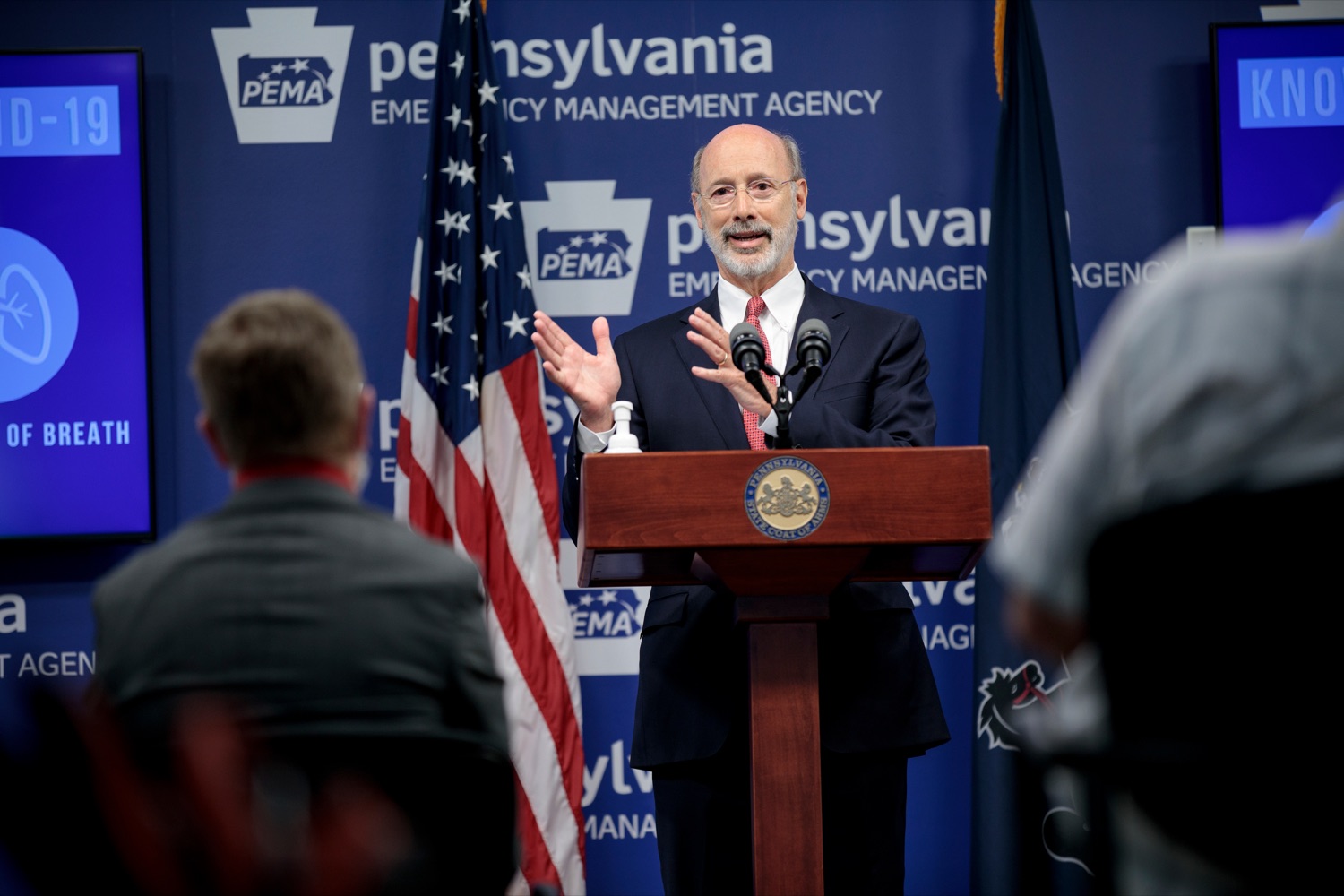
Governor Tom Wolf speaks during a press conference addressing the 2019 Novel Coronavirus (COVID-19) in Pennsylvania, inside PEMA headquarters on Wednesday, June 10, 2020.

Harrisburg, PA – Governor Tom Wolf today noted that research confirms the importance of wearing masks to stop the spread of COVID-19 and that Pennsylvanians are required to wear masks when entering any business in all counties in both yellow and green phases of reopening.

“As most counties are in or will soon be in the green phase of reopening, mask-wearing is a vital measure to help stop the spread of COVID-19,” Gov. Wolf said. “Pennsylvania has emerged as a leader among states for reduced cases amid increased reopening and we want that to continue to keep people safe and healthy while returning to many of the activities we enjoyed before COVID.”

The mask requirement is part of Secretary of Health Dr. Rachel’s Levine’s order, “Directing Public Health Safety Measures for Businesses Permitted to Maintain In-person Operations,” which pertains to all counties regardless of the phase of reopening. The order requires businesses to enforce mask-wearing unless someone has an underlying health condition that prevents them from wearing a mask. Children two or younger are not required to wear masks.

According to a recent study in the Institute of Physics, wearing simple medical masks or improvised facial coverings reduces community exposures from asymptomatic, but unknowingly infectious, individuals.

The study concludes that while people may perceive them to be ineffective or burdensome to wear, “wearing some form of exhaled barrier (mask) out in public during pathogen outbreaks is an altruistic act serving not only as a form of enhanced cough or sneeze etiquette, but also to reduce the aerosols emitted from normal breathing or when talking. Without daily testing, nobody can be certain that they are not an asymptotic disease vector. Scientifically, this is a positive step towards helping combat the current COVID-19 pandemic.”

U.S. Surgeon General Dr. Jerome Adams took to twitter on Sunday to advise that mask-wearing is contributing to and not infringing on freedom, tweeting in part, “Some feel face coverings infringe on their freedom of choice- but if more wear them, we’ll have MORE freedom to go out.”

In addition to mask wearing, Gov. Wolf and Sec. of Health Dr. Rachel Levine have advised that robust testing and contact tracing in green counties are keys to safe, phased reopening.

The state continues to increase testing and ramp up contact-tracing efforts. As of June 18 (the most recent data available), there are a total of 518 contact tracers, and a total of 4,161 contacts being monitored.

The Department of Health received a total of 89,350 test results in the past seven days, an average of 12,764 a day. The 30-day average of test results received is more than 13,934.

There were 2,763 total cases added to investigations for the week of June 12 through 18.

“Mask-wearing needs to be a part of our everyday routines,” Gov. Wolf said. “When you leave the house, grab your keys, your wallet and your mask. Mask-wearing has proven to be an important deterrent to the spread of the virus and keeping Pennsylvanians safe and healthy is the goal as we reopen and continue our mitigation efforts.”

The state’s business guidance outlines mask-wearing requirements and additional safety parameters for both employees and customers.

Read more on Gov. Wolf’s Process to Reopen PA here.

DOH Report: 510 Positives Bring PA Total to 82,696

Harrisburg, PA – The Pennsylvania Department of Health today confirmed as of 12:00 a.m., June 23, that there are 510 additional positive cases of COVID-19, bringing the statewide total to 82,696. All 67 counties in Pennsylvania have cases of COVID-19.

There are 6,464 total deaths attributed to COVID-19, an increase of 38 new deaths. County-specific information and a statewide map are available here.

“As we move closer to having the entire state in the green phase, we must remain committed to protecting against COVID-19,” Secretary of Health Dr. Rachel Levine said. “Pennsylvania has been a model for the country on how to reopen effectively using a careful, measured approach. However, the virus has not gone away. Each of us has a responsibility to continue to protect ourselves, our loved ones and others by wearing a mask, maintaining social distancing and washing our hands frequently. Together we can protect our most vulnerable Pennsylvanians, our essential workers and our healthcare system.”

Mask wearing is required in all businesses in yellow and green phases of reopening. Consistent mask wearing, even in counties in the green phase, could have lasting benefits as a COVID-19 surge is possible this fall.

There are 631 patients who have a positive serology test and either COVID-19 symptoms or a high-risk exposure, which are considered probable cases and not confirmed cases. There are 596,407 patients who have tested negative to date. Of the patients who have tested positive to date the age breakdown is as follows:

  • Nearly 1% are ages 0-4;
  • 1% are ages 5-12;
  • 2% are ages 13-18;
  • Nearly 7% are ages 19-24;
  • Nearly 37% are ages 25-49;
  • Nearly 25% are ages 50-64; and
  • Nearly 28% are ages 65 or older.

Most of the patients hospitalized are ages 65 or older, and most of the deaths have occurred in patients 65 or older. More data is available here.

In nursing and personal care homes, there are 17,294 resident cases of COVID-19, and 3,082 cases among employees, for a total of 20,376 at 669 distinct facilities in 49 counties. Out of our total deaths, 4,410 have occurred in residents from nursing or personal care facilities. A county breakdown can be found here.

Approximately 6,260 of our total cases are in health care workers.

For the latest information for individuals, families, businesses and schools, visit “Responding to COVID-19” on pa.gov.

Currently, all 67 counties are in the yellow or green phase of reopening.

Statewide – The Wolf Administration has since noon, June 22:

The Wolf Administration stresses the role Pennsylvanians play in helping to reduce the spread of COVID-19:

  • Wash your hands with soap and water for at least 20 seconds or use hand sanitizer if soap and water are not available.
  • Cover any coughs or sneezes with your elbow, not your hands.
  • Clean surfaces frequently.
  • Stay home to avoid spreading COVID-19, especially if you are unwell.
  • If you must go out for a life-sustaining reason, please wear a mask.

Updated Coronavirus Links: Press Releases, State Lab Photos, Graphics

All Pennsylvania residents are encouraged to sign up for AlertPA, a text notification system for health, weather, and other important alerts like COVID-19 updates from commonwealth agencies. Residents can sign up online at www.ready.pa.gov/BeInformed/Signup-For-Alerts.

UPPER FAIRFIELD TOWNSHIP RECYCLING DROP OFF SITE LOCATION HAS REOPENED TO THE PUBLIC

Lycoming County – Lycoming County Resource Management Services has reopened one additional site at Upper Fairfield Township, located at the municipal building.

If you or anyone in your household has COVID19, please throw away your recyclables. If you do not wish to visit the drop off sites, please know single stream recycling is available in Lycoming County. Reach out to your waste hauler for details.

Recycling drop off site has reopened at Upper Fairfield Township, located at the municipal building. Please know that the recycling site no longer has steps to use the plastics/metals container.

Please be aware that collection procedures have changed. To better accommodate the inbound recyclables and help with its transportation, more materials will be combined:

1. FIBER/PAPERS which include magazines, newspapers, chipboard, office paper junk mail, and cardboard that has been broken down are all acceptable into one container.

2. PLASTICS BOTTLES 1&2/METAL CANS which include plastic bottles/jars #1&2 only, tin/steel cans, and aluminum cans are all acceptable into one container.

3. GLASS BOTTLES/JARS are still acceptable and are still separated by color (clear/brown/green).

PLASTIC BAGS ARE NOT ACCEPTABLE IN THE RECYCLING CONTAINERS, PLEASE EMPTY ANY BAGGED MATERIAL AND TAKE THE BAGS BACK HOME WITH YOU (only exception is for shredded office paper, please put your shredded office paper in a clear bag).

Thank you for your recycling participation. We will release updates as new sites begin to open. Please know that you may recycle at any of the open Lycoming County recycling drop off sites regardless of your municipality. For an updated list of open drop off sites, please check our website www.lcrms.com.

Gov Wolf Thanks Pennsylvania’s Food Banks for Helping Those in Need

Harrisburg, PA – Governor Tom Wolf is thanking food banks, farmers, volunteers and others across the state for helping to feed Pennsylvania families during the pandemic. Today, the governor visited the York County Food Bank’s East York Emergency Food Hub, which provides groceries to approximately 2,000 families each Tuesday from 4 p.m. to 7 p.m.

“Pennsylvania’s network of food banks is helping to provide fresh and nutritious meals for Pennsylvania families as the state safely reopens,” said Gov. Wolf. “I want to thank all of the volunteers, farmers, food producers, non-profits and businesses that are donating and supporting food banks across the state.”

The York County Food Bank has provided 2.4 million meals and volunteers donated more than 4,000 hours at drive-thru, walk-thru and pop-up distribution at locations throughout the county since the COVID-19 pandemic started.

“We are very thankful that Governor Wolf has chosen to take time out of his busy schedule to visit the York County Food Bank and see firsthand our operations,” said Jennifer Brillhart, President & CEO, York County Food Bank. “Our staff and volunteers have been working hard to meet the increased demand for food due to the COVID-19 pandemic and we are incredibly grateful for the support of Governor Wolf and the Pennsylvania Department of Agriculture for providing us with the resources to meet the critical need.”

The Wolf Administration has invested in several initiatives to address food insecurity, including $50 million through the USDA’s Farmers to Families Food Box program to purchase surplus milk and other dairy products, chicken, pork and fresh produce from Pennsylvania farmers who lost markets for their products because of the COVID-19 pandemic, and $40 million in funding through the federal Coronavirus Aid, Relief, and Economic Security (CARES) Act to support Pennsylvania’s dairy industry and food security programs, following months of uncertainty and loss from the COVID-19 pandemic.

Specifically, $15 million will provide an opportunity for dairy farmers to receive direct relief payments and $5 million will go to reimburse farmers donating dairy products through the Pennsylvania Agricultural Surplus System (PASS). This Department of Agriculture program helps food producers donate safe food to food banks and be reimbursed for harvesting, processing, packaging and transporting costs of donated food.

An additional $15 million will be used for cash grants to counties for the purchase and distribution of food to low income individuals through the State Food Purchase Program and $5 million will go to the PASS program to reimburse the agricultural industry for the costs involved in harvesting, processing, packaging and transporting food that they donate to the charitable food system.

Visitors to food banks can get groceries through June 25 without providing financial eligibility under the Disaster Household Distribution program, through The Emergency Food Assistance Program (TEFAP). The Department of Agriculture estimates that in 2020, $80 million in food will be distributed through Pennsylvania’s charitable food system in all 67 counties, using the state’s allocation of federal TEFAP funds. More food security resources are available here.

“I was proud to meet the volunteers at the York County Food Bank and thank them for their efforts to help our neighbors in need,” said Gov. Wolf. “They exemplify the spirit in community after community to help families keep food on the table as we all work together to safely move Pennsylvania forward.”

A Baseball Story In The Birthplace Of Little League Baseball – PART XVIII

Attorney General Josh Shapiro (top), Roger Freed WAHS 9th grade principal (bottom left)
Dr. Susan L. Bigger, WASD Assistant Superintendent and Brandon Pardoe WAHS head principal (bottom right)

The following is the result of a more than 18-month long investigation
by Talk Williamsport
into the Williamsport Area High School Baseball Team trip
to Myrtle Beach, South Carolina in the spring of 2018.

This story is graphic and contains details related to multiple indecent sexual assaults.

The author and editor of this story have made the editorial decision to not publish the names of the individuals under the age of 18 at the time of the incident who have been clearly identified as committing these acts in this case since they have not been formally charged with a crime.

A Baseball Story In The Birthplace Of Little League Baseball

IF NOTHING HAPPENED IN MYRTLE BEACH

WHY WON’T THE WASD TELL US THE STORY?

PART XVIII

By Todd Bartley, Talk Williamsport

News@talkwilliamsport.com


LITTLE LEAGUE COMPLEX HOSTED 2018 MILLIONAIRES BASEBALL BANQUET

Talk Williamsport has obtained photographic evidence the cafeteria area located in the Little League headquarters building was used as the venue to celebrate the 2018 Williamsport Millionaires baseball team.

Individuals appearing in multiple photos are Nick Caringi, former Williamsport assistant baseball coach and Little League employee as well as current head coach Kyle Schneider, assistant baseball coach Joel Worthington, athletic director Sean McCann, Jamie Joy, Little League employee seated at the same table with his father-in-law criminal defense attorney George Lepley.

The obtained photos were compared to those from previous Little League luncheons.

Easily identifiable in the photos is “champions” on the wall and a multitude of Little League Word Series team photos with many different color uniforms identifying the region of the world they hail from.

Based on the time stamps of the photos, the banquet occurred on June 15, 2018.

Based upon the exclusive reporting of FSW in this series; that puts it just 10 days after the June 5, 2018 conclusion of the investigations run by WAHS principal Brandon Pardoe and former Lycoming County chief detective Willie Weber.

FSW reached out to Little League with the following questions recently.

Was the Little League complex or facility in South Williamsport used by the Williamsport High School Baseball team in 2018 for an awards banquet?

If so, was it rented?

Is the facility available for rentals to any team, group or organization?

On Monday morning, Kevin Fountain, Director of Media Relations for Little League International provided the following:

“Thanks for reaching out. As we have shared with your previous requests on this matter, it would be inappropriate for us to comment. Have a nice week.”

When did it become “inappropriate for us to comment” when asking about the use of a Little League International facility?

JOHN DOE #1, who was the victim of “criminal sexual misconduct” does not appear in any of the awards banquet photos since he had previously been kicked off the team.

Instead the people that conspired to keep the story quiet were hosted by Little League and its employees.

Was the same rigorous vetting process employed by Little League International to allow people on the complex for the Little League World Series prior to hosting this event or was it yet another baseball courtesy?

To be fair, was Little League International informed by any of its employees who were on the Myrtle Beach trip that “criminal sexual misconduct” occurred?

Did former Lycoming County chief detective Willie Weber and Little League World Series team host (uncle) inform Little League International he was part of the investigation in this matter?

Or did Weber tell Little League International it was just a “prank”?

Or was it just “boys being boys”?

Does that make the Little League International response even more perplexing with their stated narrative in regard to protecting children?


FREED JOINED WASD INVESTIGATION IN 2018

FSW has confirmed, Roger Freed, WAHS 9th Grade Principal was the previously unidentified administrator that participated in the investigations conducted by the WASD.

His identity was not provided in the Right to Know answers provided to FSW by the WASD.

Freed is a direct report to WAHS head principal Brandon Pardoe.

According to an article published by the Sun-Gazette on January 15, 2018, Roger Freed was appointed 9th Grade Principal at Williamsport Area High School.

FSW continues to develop information relating to the role Freed played in this case.


BIGGER TITLE IX TROUBLE?

Dr. Susan Bigger, WAHS Assistant  Superintendent at the time of the incident in Myrtle Beach in 2018 and subsequent investigations served in a capacity to address Title IX issues related to students.

The WASD provided at the bottom of page 1, its “Nondiscrimination Policy” contained in the Students Rights and Responsibilities Handbook 2017-2018; which addressed issues related to the Title IX Education Amendment of 1972, Title VI of the Civil Rights Act of 1964, Section 504 of the Rehabilitation Act of 1973 and the Americans with Disability Act of 1990.

The Williamsport Area School District is an equal opportunity education institution and will not discriminate on the basis of race, color, national origin, sex, and handicap in its activities, programs, or employment practices as required by Title VI of the Civil Rights Act of 1964, Title IX Education Amendment of 1972, Section 504 of the Rehabilitation Act of 1973 and the Americans with Disability Act of 1990. 

For information regarding civil rights or grievance procedures, services, activities, and facilities that are accessible to and usable by handicapped individuals, contact:  Mrs. Anne Logue, Director of Human Resources, for issues related to staff, and Dr. Susan Bigger, Assistant  Superintendent, for student related issues. 

Both are located at the Williamsport Area School District, 2780 West Fourth Street, Williamsport, PA  17701. Telephone number 570-327-5500, ext. 40210 for Mrs. Logue and ext. 40511 for Dr. Bigger

A video depicts what Lycoming County District Attorney Ryan Gardner described as “criminal sexual misconduct” and WASD Solicitor Fred Holland characterized as “indecent and inappropriate conduct” and has subsequently been referred to PA Attorney General Josh Shapiro for review.

Do the acts depicted on video amount to a Title IX violation?

Do the acts depicted on video amount to a deprivation of a student’s civil rights?

What if any of the victims noted in this series had conditions that qualify under the Americans with Disability Act of 1990?

In PART VIII Suzanne Estrella, Pennsylvania Coalition Against Rape (PCAR), Legal Director offered the following on the Title IX issues brought up in “A Baseball Story” series of stories.

Title IX is a civil rights law that provides for equal education opportunity.  It prohibits schools that receive federal funding from discriminating on the basis of sex.

Title IX mandates that schools have a prompt and effective response to sexual assault that occurs in context of the education program or activity – this would include a sexual assault on a field trip.

Title IX also requires schools to provide some type of prevention training.

She also weighed in on the crimes alleged to have occurred, in Pennsylvania, “the crimes described in the FSW series of stories include sexual assault, battery, possibly sextortion, and the unlawful dissemination of an intimate image.”

To date, no criminal charges have been filed in South Carolina or Pennsylvania in this case.


Additionally from From PART VIII  of this series:

MILLER LAWSUIT AND ASSERTIONS ON THE RECORD

Miller in his lawsuit claims to be harmed by a published MBPD Police Report previously reported as listing him as the perpetrator instead of a witness to a simple assault case.

In fact, his lawyer contacted FSW on New Year’s Eve 2019 via e-mail proclaiming Miller to be the “hero and not the villain.”

He cites in #24 of his subsequently filed complaint, “While on break from coaching duties during the baseball tournament, Mr. Miller and Coaches Kyle Schneider and Joel Worthington were on the balcony of a hotel room overlooking a nearby beach when they witnessed an unknown man and woman arguing on the beachfront.”

Is it plausible this room would be part of a room list documenting where everyone on the trip was staying?

FSW already published a corrective statement that Miller was not arrested as a result of this incident.

The MBPD publicly searchable database provides names of parties involved in incidents.

#24 of the Miller complaint points out some significant deficiencies however.

Why can’t Miller tell us what hotel or room number that balcony view was from?

When Miller says, “While on break from coaching duties during the baseball tournament”, does that mean his responsibilities only applied when he was on the field “coaching” and not at the hotel or anywhere else in Myrtle Beach?

Is it the same mindset now since Miller resigned and his fellow witness and current WAHS head coach Kyle Schneider subscribes too?

Miller also claims in his complaint he has no knowledge of any of the “indecent or inappropriate behavior of a baseball player in Myrtle Beach” and only learned of it through rumors in the summer of 2018.

What’s worse, not having any knowledge of the whereabouts of the student athletes a coach is responsible for while in Myrtle Beach or potentially playing an active role in a cover-up of what obviously took place?

The WASD has already said in the RTKL responses under the penalty of perjury that there was no hotel room assignment list and when they asked Miller for one he could not provide one.

There were no adult chaperones on the trip other than the coaching staff which according to the Miller complaint he and a pair of coaches were on an unknown hotel balcony in Myrtle Beach.


MILLER ATTORNEYS CONFIRM CARNEVALE IN MYRTLE BEACH

Attorneys for Ryan Miller e-mailed FSW on January 9, 2020 expressing their client’s issues with “A Baseball Story” series. Ironically, the mailed versions of that same letter showed up to the offices of Colonial Radio Group of Williamsport at the end of this past week coinciding with the filing of the aforementioned lawsuit.

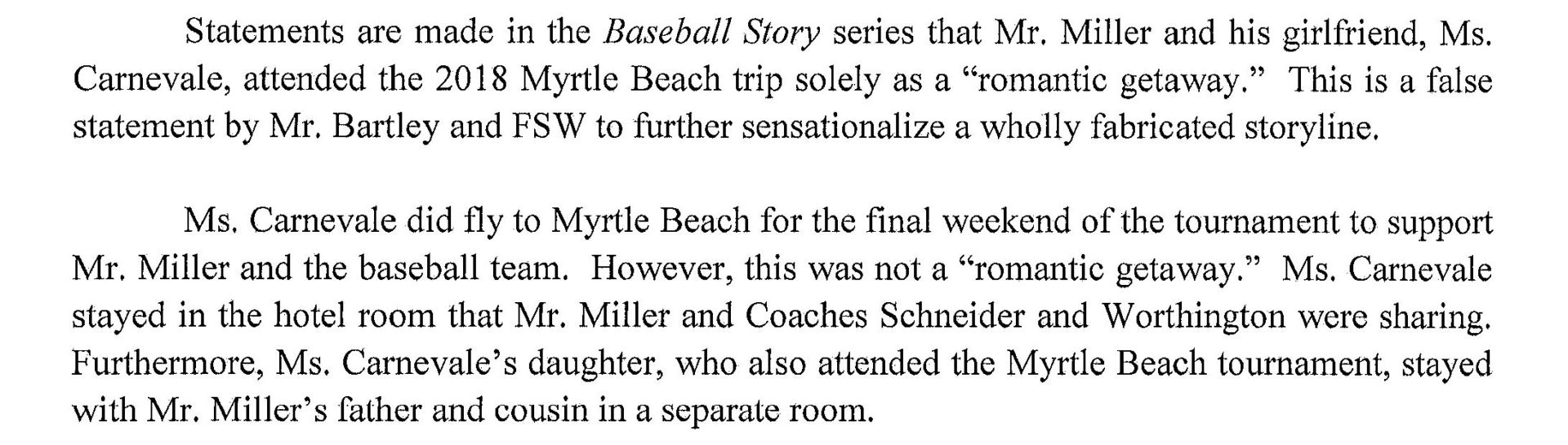
Miller conveniently omitted the “romantic getaway” issue from his lawsuit.

Talk Williamsport is still waiting for a response from the attorneys for Miller on identifying not only the hotel name but the room number as well.

Miller also conveniently omitted from the complaint him showing up to a game at Bowman Field drunk.

Is that because he is unable to disprove this fact?

Why did WASD hire a former assistant baseball coach with two prior DUI’s as a head coach?

Was that the decision of the WAHS Athletic Director or WAHS Principal Brandon Pardoe?


FAIR WARNING GIVEN TO MILLER AND LAWFIRM REPRESENTING HIM BY FSW

Upon receiving the letter from the Miller attorneys; FSW gave notice to Marshall and Page IV that their client was facing a civil lawsuit from JOHN DOE #1 and that sources confirmed the criminal case had been reopened. The reopening brought up possible criminal liability for the head coach and others on the trip.

With these facts in hand, McNerney, Page, Vanderlin & Hall filed the lawsuit against FSW and others, anyway.


WASD SCHOOL CONDUCT MANUAL COMPLETELY IGNORED

FSW obtained a copy of the WAHS School Conduct Guidelines, in Appendix II, under Categories – IV it states:

Acts which result in violence to another person or property or which pose a direct threat to the safety of others in the school. These acts are clearly criminal and are so serious that they always require administrative actions which result in the immediate removal of the student from the school, the intervention of law enforcement authorities and  actions by the board of school directors.

Examples

  • Unmodified conduct
  • Assault/battery
  • Extortion
  • Bomb threat
  • Possession/use/transfer/of dangerous weapons
  • Vandalism
  • Possession/sale of stolen property
  • Arson
  • Furnishing/selling/Possession of unauthorized substances

Procedures

a. The administration verifies the offense, confers with the staff involved and meets with the student.

b. The student is immediately removed from the school environment.

c. Law enforcement officials are contacted.

d. A complete and accurate report is submitted to the superintendent for board action.

e. The student is given a full due process hearing before the board.

Disciplinary Option & Responses

  • Expulsion
  • Alternative schools
  • Police intervention

As noted in this series, WASD administrators continue to assert law enforcement made them aware of the alleged incident. Even if that is true, the subsequent procedures were not followed.

The evidence to that effect is found in PART VII.

After issuing its first statement in the matter in nearly 2 years the WASD also offered the following, “The Williamsport Area School District does not condone inappropriate and indecent behavior.”

Talk Williamsport has obtained a photo of ALLEGED PERPETRATOR #1 in uniform after the 2018 District II Class 6A Baseball Championship game with his parents on each side and wearing a District II Championship medal.

Why was ALLEGED PERPETRATOR #1 in uniform after the 2018 District II Class 6A Baseball Championship game with his parents on each side and wearing a District II Championship medal and not suspended for the rest of the season?

Was it yet another baseball courtesy?


BASED ON ACT 140 PENSIONS ARE AT RISK IN THIS CASE

FSW researched state pension forfeiture statues and found the Pension Forfeiture Overview.

The right of a person to receive any retirement benefit from PSERS is subject to forfeiture as provided by the Public Employee Pension Forfeiture Act (“Forfeiture Act”) or ACT 140.

The law mandates that all service and benefits payable to a PSERS member be forfeited if the member is found guilty of, or enters a plea of guilty or nolo contendere to, any crime identified in the Forfeiture Act, when the crime is committed through the member’s position as a public employee or official or when the member’s public employment places the member in a position to commit the crime(s).

All Pennsylvania criminal offenses that are classified as felonies or punishable by a term of imprisonment exceeding five years are forfeitable offenses.   Several misdemeanor crimes also are forfeitable offenses.

By way of example, the list of forfeitable Pennsylvania crimes includes, but is not limited to: theft by unlawful taking or disposition; theft by deception; theft of services; theft by failure to make required disposition of funds received; forgery; tampering with records; bribery; perjury; misapplication of entrusted property and property of government or financial institutions; tampering with public records or information; criminal attempt, solicitation and conspiracy; murder; voluntary manslaughter; involuntary manslaughter; aggravated assault; retail theft; identity theft; corruption of minors; unlawful contact with minor; distribution of computer virus; bomb threats; and the sexual offenses listed in Chapter 31, Subchapter B of the Pennsylvania Crimes Code.

In addition, any crime set forth in Federal law or the laws of any other state is a forfeitable offense, if the crime is substantially the same as any forfeitable Pennsylvania crime.

The Public Employee Pension Forfeiture Act 1978-140 (Act 140) applies to all SERS members who commit certain crimes in relation to their employment. Enforcement of Act 140 is mandatory. Pennsylvania courts have held that SERS has no discretion in its application. It does not matter if the crime is relatively minor compared to the value of pension benefits; if Act 140 is triggered, it must be applied.

The Pennsylvania Constitution and Judicial Code also contain forfeiture provisions that apply to members of the judiciary, for whom forfeiture can occur even if no crime has been committed.

Act 140 requires forfeiture of all pension and retirement benefits by any SERS member who commits certain crimes.

Also forfeited are any benefits for the member’s beneficiaries and survivor annuitants. The only benefits Act 140 allows a SERS member to receive are his or her contributions paid into the pension fund, without interest. Even these may be lost, however, because they can be used to pay fines and restitution associated with the criminal conviction.

Act 140 is triggered if a SERS member is convicted of, pleads guilty, or has no defense to any listed crime committed through the member’s public office or position or when public employment puts the member in a position to commit the crime.

Pennsylvania crimes covered by Act 140 are found in 43 P.S. Section 1312. Federal crimes that are substantially the same as the Pennsylvania crimes are also covered by Act 140.

To paraphrase, they are:

  • Any of the criminal offenses set forth in Subchapter B of Chapter 31 (relating to definition of offenses) when the criminal offense is committed by a school employee as defined in 24 Pa. C.S. Section 8102 (relating to definitions) against a student
  • Section 3922 (relating to theft by deception) when the criminal culpability reaches the level of a misdemeanor of the first degree or higher
  • Section 3923 (relating to theft by extortion) when the criminal culpability reaches the level of a misdemeanor of the first degree or higher
  • Section 3926 (relating to theft of services) when the criminal culpability reaches the level of a misdemeanor of the first degree or higher
  • Section 3927 (relating to theft by failure to make required disposition of funds received), when the criminal culpability reaches the level of a misdemeanor of the first degree or higher
  • Section 4101 (relating to forgery)
  • Section 4104 (relating to tampering with records or identification)
  • Section 4702 (relating to threats and other improper influence in official and political matters)
  • Section 4902 (relating to perjury)
  • Section 4903(a) (relating to false swearing)
  • Section 4904 (relating to unsworn falsification to authorities)
  • Section 4906 (relating to false reports to law enforcement authorities)
  • Section 4909 (relating to witness or informant taking bribe)
  • Section 4910 (relating to tampering with or fabricating physical evidence)
  • Section 4911 (relating to tampering with public records or information)
  • Section 4952 (relating to intimidation of witnesses or victims)
  • Section 4953 (relating to retaliation against witness, victim or party)
  • Section 5101 (relating to obstructing administration of law or other governmental function)
  • Section 5301 (relating to official oppression)
  • Section 5302 (relating to speculating or wagering on official action or information)

Pension Forfeiture (DC Plan)

The right of a person to receive any retirement benefit from PSERS is subject to forfeiture as provided by the Forfeiture Act (refer to Pension Forfeiture Overview section).  A member forfeits all accumulated employer contributions and investment earnings, if any, on those contributions in the member’s DC account.  A member’s contributions to the DC Plan, including all mandatory employee, voluntary contributions, and all amounts rolled-over into the DC plan with all investment earnings, if any, on all such contributions, shall be available for restitution.

If you need additional information about the Pension Forfeiture Act and how it relates to PSERS retirement benefits, or need to report a potential pension forfeiture matter to PSERS, please contact your PSERS’ Employer Service Center representative.

Putting aside for a moment that WAHS Head Principal Brandon Pardoe never reached out to the MBPD as a mandated reporter to inform them he had been informed by law enforcement of the incident.

When Pardoe received a call from MBPD Detective Aiesi in Septmeber 2018, was he obligated under ACT 140 to disclose the fact he ran an investigation into the events of the Myrtle Beach trip?

When he received a second call the same day from another MBPD Detective, was the fact he ran an investigation into the events of the Myrtle Beach trip disclosed then?

Since the recorded phone conversation makes no mention of it, did Pardoe commit any number of these offenses;

  • Section 4902 (relating to perjury)
  • Section 4903(a) (relating to false swearing)
  • Section 4904 (relating to unsworn falsification to authorities)
  • Section 4906 (relating to false reports to law enforcement authorities)

thus, putting his pension in jeopardy?


According to the RADIO SHOW CALLER CLAIMS in PART XVI:

“EVERYONE INVOLVED KNEW INSTANTANEOUSLY AFTER IT HAPPENED”


FSW has the following question for the current and former WASD School Board members, administration, teachers, staff, coaches and parents; was it all worth it?

PART XIX is forthcoming.


LINKS TO 18-PART SERIES PUBLISHED BY Talk Williamsport

A Baseball Story In The Birthplace Of Little League Baseball – PART XVIII

BREAKING NEWS: PA AG Press Office confirms receipt of Criminal Sexual Misconduct referral from DA Gardner

A Baseball Story In The Birthplace Of Little League Baseball – PART XVII

A Baseball Story In The Birthplace Of Little League Baseball – PART XVI

EXCLUSIVE: AG Shapiro press office on referral: “If and when we receive it, it will be promptly reviewed”

A Baseball Story In The Birthplace Of Little League Baseball – PART XVII

BREAKING NEWS: PA AG Press Office confirms receipt of Criminal Sexual Misconduct referral from DA Gardner

UPDATE: Charges filed in Greater Latrobe Junior High hazing case cited in “A Baseball Story”

A Baseball Story In The Birthplace Of Little League Baseball – PART XVI

EXCLUSIVE: AG Shapiro press office on referral: “If and when we receive it, it will be promptly reviewed”

BREAKING NEWS: District Attorney Gardner refers Myrtle Beach case to PA Attorney General – PART XV

A Baseball Story In The Birthplace Of Little League Baseball – PART XIV

A Baseball Story In The Birthplace Of Little League Baseball – PART XIII

A Baseball Story In The Birthplace Of Little League Baseball – PART XII

A Baseball Story In The Birthplace Of Little League Baseball – PART XI

A Baseball Story In The Birthplace Of Little League Baseball – PART X

A Baseball Story In The Birthplace Of Little League Baseball – PART IX

A Baseball Story In The Birthplace Of Little League Baseball – PART VIII

A Baseball Story In The Birthplace Of Little League Baseball – PART VII

A Baseball Story In The Birthplace Of Little League Baseball – PART VI

A Baseball Story In The Birthplace Of Little League Baseball – PART V

A Baseball Story In The Birthplace Of Little League Baseball – PART IV

A Baseball Story In The Birthplace Of Little League Baseball – PART III

A Baseball Story In The Birthplace Of Little League Baseball – PART II

A Baseball Story In The Birthplace Of Little League Baseball – PART I

Fans often ask me, what if?

Millionaire Baseball Mayhem in Myrtle Beach

Gov. Wolf: Pennsylvania Reduced Prison Population by Record-Setting 3,471 since March 1 

Harrisburg, PA – Governor Tom Wolf announced today that since March 1, the population of those in state correctional facilities has been reduced by 3,471 individuals, the largest multiple-month decrease ever experienced by the Department of Corrections and one that likely helped the department reduce the number of COVID-19 cases in facilities.

“When COVID-19 arrived, the Pennsylvania Department of Corrections met the challenge of keeping the general public safe while protecting its inmate population from this easily transmissible disease,” Gov. Wolf said. “The department has been successful at keeping COVID-19 from spreading widely in the congregate settings of correctional facilities.”

In the three-plus months since COVID-19 was first identified in Pennsylvania, less than 1 percent of the state prison population has tested positive. Ultimately, the inmates inside state correctional institutions have proven so far to be more secure from COVID-19 than the general population, where the mortality rate is 90% higher than it is in the state’s correctional facilities as of today.

The population reduction includes furloughing paroled individuals from centers to home plans; working with the parole board to maximize parole releases; reviewing parole detainers for those in county jails and state prisons; expediting the release process for anyone with a pending approved home plan; reviewing and releasing inmates who are beyond their minimum sentences; and implementing the temporary reprieve program that has allowed Gov. Wolf to issue reprieves to 159 inmates during the pandemic.

These releases are in addition to preexisting criminal justice reform efforts that have reduced Pennsylvania’s prison population from 48,881 inmates when Gov. Wolf entered office at the beginning of January 2015 to 41,738 inmates today. That 7,143 decrease in population in under five years has allowed the state to reduce taxpayer costs by closing facilities while enabling more Pennsylvanians to resume their lives – all without an increase in the state’s crime rate.

“The Department of Corrections takes pride in its ability to keep inmates safe and will continue to prioritize health and wellness during the COVID-19 crisis,” DOC Sec. John Wetzel said. “We will continue to seek improvements in our criminal justice system that minimizes the number of incarcerated individuals while providing the highest degree of safety to every Pennsylvanian.”

Pennsylvania has taken a bipartisan approach to criminal justice reform and in recent years has:

  • Passed Justice Reinvestment 2 addressing the high cost of incarceration in the state, strengthening support for county probation programs and fixing inadequate sentencing guidelines, and reforming the post-trial criminal justice system.
  • Created a Fair-Chance hiring policy for state agencies that removes the criminal conviction question, otherwise known as “banning the box,” from non-civil service employment applications for agencies under the governor’s jurisdiction.
  • Signed the “Clean Slate” bill, the first of its kind in the nation, to help those who have committed low-level offenses and have paid their penalty get back on the path to a blemish-free record, removing potential roadblocks to jobs, housing, health care, and education.
  • Signed Act 95 of 2018, eliminating driver’s license suspensions for non-driving infractions.
  • Signed Act 146 of 2018, extending the time a convicted individual has to file a post-conviction relief action to one year, from what was 60 days under current law.
  • Signed Act 147 of 2018, updating Pennsylvania’s DNA testing law to reflect significant advances in technology and the lessons learned by criminal justice professionals since 2002. The legislation removes the supervision requirement that only people serving a sentence can apply for DNA testing.
  • Signed Act 148 of 2018, a victim protection bill regarding housing options and emergency transfers.

Find more information on Pennsylvania’s response to COVID-19 here.

Find more information on Gov. Wolf’s Process to Reopen PA here.

DOH Report: 456 Positives Bring PA Total to 82,186

Harrisburg, PA – The Pennsylvania Department of Health today confirmed as of 12:00 a.m., June 22, that there are 456 additional positive cases of COVID-19, bringing the statewide total to 82,186. All 67 counties in Pennsylvania have cases of COVID-19.

There are 6,426 total deaths attributed to COVID-19, an increase of 3 new deaths. County-specific information and a statewide map are available here.

“As we move closer to having the entire state in the green phase, we must remain committed to protecting against COVID-19,” Secretary of Health Dr. Rachel Levine said. “Pennsylvania has been a model for the country on how to reopen effectively using a careful, measured approach. However, the virus has not gone away. Each of us has a responsibility to continue to protect ourselves, our loved ones and others by wearing a mask, maintaining social distancing and washing our hands frequently. Together we can protect our most vulnerable Pennsylvanians, our essential workers and our healthcare system.”

Mask wearing is required in all businesses in yellow and green phases of reopening. Consistent mask wearing, even in counties in the green phase, could have lasting benefits as a COVID-19 surge is possible this fall.

There are 631 patients who have a positive serology test and either COVID-19 symptoms or a high-risk exposure, which are considered probable cases and not confirmed cases. There are 585,662 patients who have tested negative to date. Of the patients who have tested positive to date the age breakdown is as follows:

  • Nearly 1% are ages 0-4;
  • 1% are ages 5-12;
  • 2% are ages 13-18;
  • 6% are ages 19-24;
  • Nearly 37% are ages 25-49;
  • Nearly 25% are ages 50-64; and
  • Nearly 28% are ages 65 or older.

Most of the patients hospitalized are ages 65 or older, and most of the deaths have occurred in patients 65 or older. More data is available here.

In nursing and personal care homes, there are 17,177 resident cases of COVID-19, and 3,053 cases among employees, for a total of 20,230 at 667 distinct facilities in 49 counties. Out of our total deaths, 4,389 have occurred in residents from nursing or personal care facilities. A county breakdown can be found here.

Approximately 6,219 of our total cases are in health care workers.

For the latest information for individuals, families, businesses and schools, visit “Responding to COVID-19” on pa.gov.

Currently, all 67 counties are in the yellow or green phase of reopening.

Statewide – The Wolf Administration has since noon, June 21:

The Wolf Administration stresses the role Pennsylvanians play in helping to reduce the spread of COVID-19:

  • Wash your hands with soap and water for at least 20 seconds or use hand sanitizer if soap and water are not available.
  • Cover any coughs or sneezes with your elbow, not your hands.
  • Clean surfaces frequently.
  • Stay home to avoid spreading COVID-19, especially if you are unwell.
  • If you must go out for a life-sustaining reason, please wear a mask.

Updated Coronavirus Links: Press Releases, State Lab Photos, Graphics

All Pennsylvania residents are encouraged to sign up for AlertPA, a text notification system for health, weather, and other important alerts like COVID-19 updates from commonwealth agencies. Residents can sign up online at www.ready.pa.gov/BeInformed/Signup-For-Alerts.

DOH Report: 464 Positives Bring PA Total to 81,730

Harrisburg, PA – The Pennsylvania Department of Health today confirmed as of 12:00 a.m., June 21, that there are 464 additional positive cases of COVID-19, bringing the statewide total to 81,730. All 67 counties in Pennsylvania have cases of COVID-19.

There are 6,423 total deaths attributed to COVID-19, an increase of 4 new deaths. County-specific information and a statewide map are available here.

“With more than half of the state now in the green phase of the process to reopen, it is essential that we continue to take precautions to protect against COVID-19,” Secretary of Health Dr. Rachel Levine said. “The commonwealth’s careful, measured approach to reopening is working as we see case counts continue to decline even as many other states see increases. But the virus has not gone away. Each of us has a responsibility to continue to protect ourselves, our loved ones and others by wearing a mask, maintaining social distancing and washing our hands frequently. Together we can protect our most vulnerable Pennsylvanians, our essential workers and our healthcare system.”

Mask wearing is required in all businesses in yellow and green phases of reopening. Consistent mask wearing, even in counties in the green phase, could have lasting positive effects as a COVID-19 surge is possible this fall.

There are 631 patients who have a positive serology test and either COVID-19 symptoms or a high-risk exposure, which are considered probable cases and not confirmed cases. There are 576,015 patients who have tested negative to date. Of the patients who have tested positive to date the age breakdown is as follows:

  • Nearly 1% are ages 0-4;
  • 1% are ages 5-12;
  • 2% are ages 13-18;
  • 6% are ages 19-24;
  • Nearly 37% are ages 25-49;
  • Nearly 25% are ages 50-64; and
  • Nearly 28% are ages 65 or older.

Most of the patients hospitalized are ages 65 or older, and most of the deaths have occurred in patients 65 or older. More data is available here.

In nursing and personal care homes, there are 17,066 resident cases of COVID-19, and 3,047 cases among employees, for a total of 20,113 at 663 distinct facilities in 49 counties. Out of our total deaths, 4,384 have occurred in residents from nursing or personal care facilities. A county breakdown can be found here.

Approximately 6,212 of our total cases are in health care workers.

For the latest information for individuals, families, businesses and schools, visit “Responding to COVID-19” on pa.gov.

Currently, all 67 counties are in the yellow or green phase of reopening.

The Wolf Administration stresses the role Pennsylvanians play in helping to reduce the spread of COVID-19:

  • Wash your hands with soap and water for at least 20 seconds or use hand sanitizer if soap and water are not available.
  • Cover any coughs or sneezes with your elbow, not your hands.
  • Clean surfaces frequently.
  • Stay home to avoid spreading COVID-19, especially if you are unwell.
  • If you must go out for a life-sustaining reason, please wear a mask.

Updated Coronavirus Links: Press Releases, State Lab Photos, Graphics

All Pennsylvania residents are encouraged to sign up for AlertPA, a text notification system for health, weather, and other important alerts like COVID-19 updates from commonwealth agencies. Residents can sign up online at www.ready.pa.gov/BeInformed/Signup-For-Alerts.